

Artificial intelligence can sound more complicated than it needs to be. For rent-to-own operators, the more useful question is simpler: What work are you already doing that AI could help you do more efficiently?
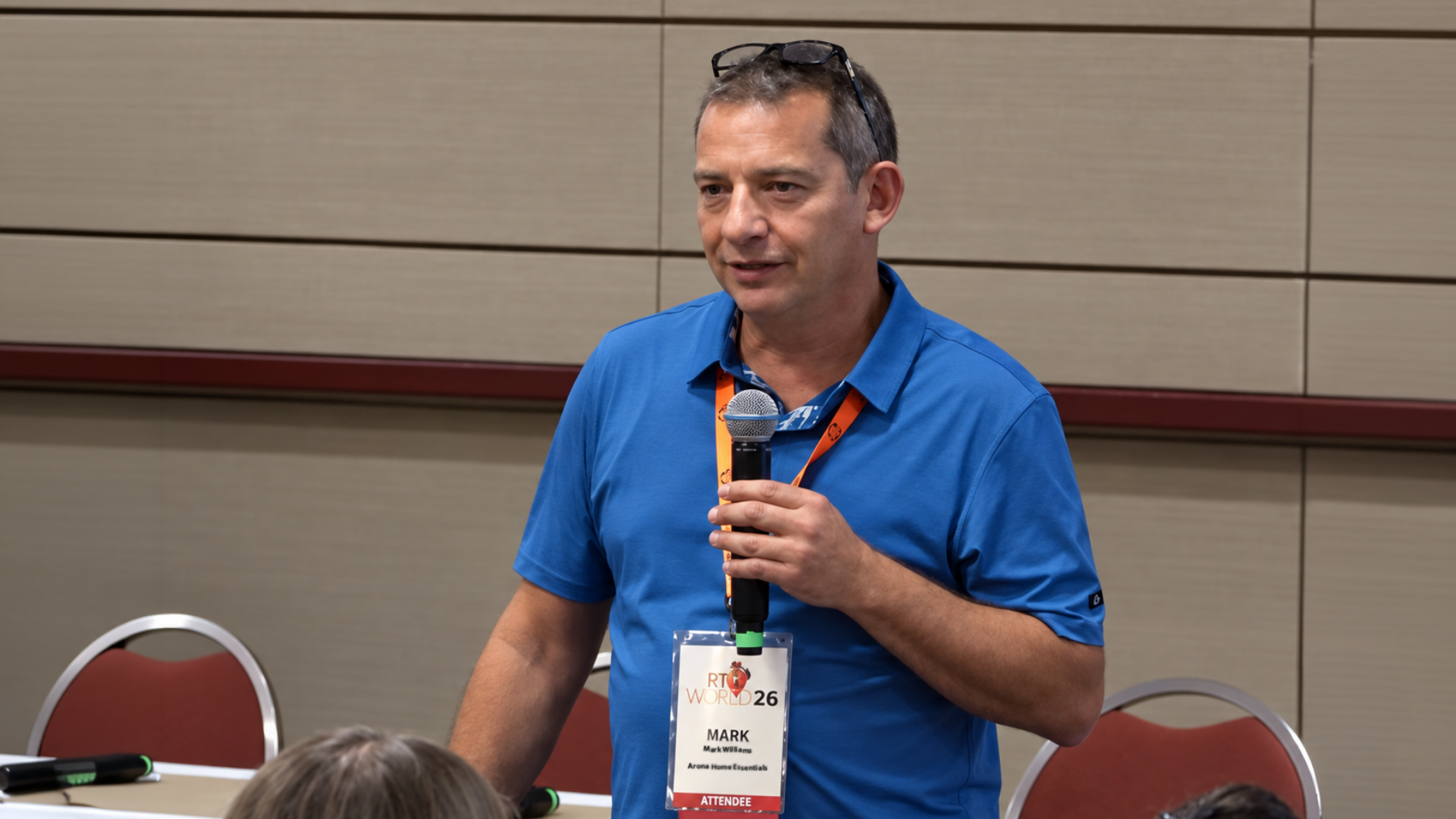
That was the focus of the educational session titled AI Without the Tech Talk: A Beginner’s Guide, presented at RTO World 2026 by Amberlee Maya, Director of Marketing and Communications for APRO, and Mark Williams, Vice President for SKC Enterprises Inc. dba Rent One. Rather than concentrating on the technology behind AI, Williams and Maya demonstrated practical applications for everyday RTO operations, including employee training, product research, inventory planning, marketing analysis, and content creation.
Start AI for Rent-to-Own Businesses With Context

One of the session’s central lessons was that an AI tool is only as useful as the information and instructions it receives. A generic AI assistant may know very little about rent-to-own terminology, company policies, or an individual store’s operations.
Maya demonstrated an approach to give AI that context through three layers of information: an industry foundation, a company profile with policies and business practices, and a store knowledge profile with location-specific details.
That context can help prevent a common problem: AI generating language that does not accurately describe rent-to-own or the company. Maya showed how a generic tool might incorrectly use terminology associated with loans, financing, APRs, borrowers, or interest. Providing clear RTO-specific source material and company guidelines gives the tool a better foundation for drafting content.
“The value is not only that AI writes faster,” Maya explained. “The value is that employees get a knowledgeable assistant” that can help them remain accurate, consistent, and on-brand.
Put AI to Work on Tasks You Already Have
Williams encouraged attendees to start with practical problems rather than trying to master everything AI can do.
For sales and product training, for example, an operator can provide a product model number and ask AI to create a quick training guide. Williams described using AI to compare products such as gaming computers, TVs, and appliances, helping him understand specifications and evaluate options. The same information can then become training material that helps employees explain products more confidently.
AI can also assist with routine communications. Williams discussed using it to draft emails, while Maya demonstrated how company context can help employees prepare customer review responses that better reflect the organization’s voice. AI can similarly generate role-playing scenarios and one-page training materials based on company policies already provided to the system.
“Don’t overthink it,” Williams told attendees. “Just try it and just put in a prompt.”
Use AI to Make Data More Useful
Williams also shared examples of AI helping with work that goes beyond writing.
For marketing analysis, he described uploading reports from advertising platforms and asking AI to organize the information into a monthly report. This allows his team to examine measures such as customer acquisition costs, return on ad spend, and marketing efficiency without manually combining every report.
He has taken a similar approach to inventory planning, supplying historical purchasing and sales information, expected category growth, and return rates to estimate future purchasing needs.
The broader lesson was to give AI a defined business problem and useful information, then evaluate whether its output improves the work. Williams recommended starting with one tool, establishing its value, measuring results, and expanding only after finding applications that work for the business.
Keep People Responsible for the Final Answer
Both speakers emphasized an important guardrail: AI output still requires human review.
Maya shared an example in which an AI-generated transcript contained incomplete information and the system supplied a person’s last name on its own. The name was incorrect. Her point was straightforward: AI can produce information that sounds convincing even when it is wrong.
Williams also cautioned against entering customer information into AI tools and encouraged businesses using AI for company work to consider plans with appropriate data-privacy protections. He framed AI as a tool for increasing a team’s capacity, not replacing the people responsible for the work.
For RTO professionals interested in getting started, the session offered a manageable approach: choose a tool, give it appropriate business context, identify a few recurring tasks, and keep a person responsible for reviewing what it produces.
APRO members can watch the full AI Without the Tech Talk: A Beginner’s Guide session replay for the live demonstrations and additional examples shared during RTO World 2026.
About SKC Enterprises Inc. dba Rent One
SKC Enterprises Inc. dba Rent One is a regional rent-to-own company with more than 100 locations across eight states. Founded in 1985, the company offers furniture, appliances, electronics, mattresses, and other home essentials through flexible rental-purchase options. Rent One has been an APRO member since 1990.

