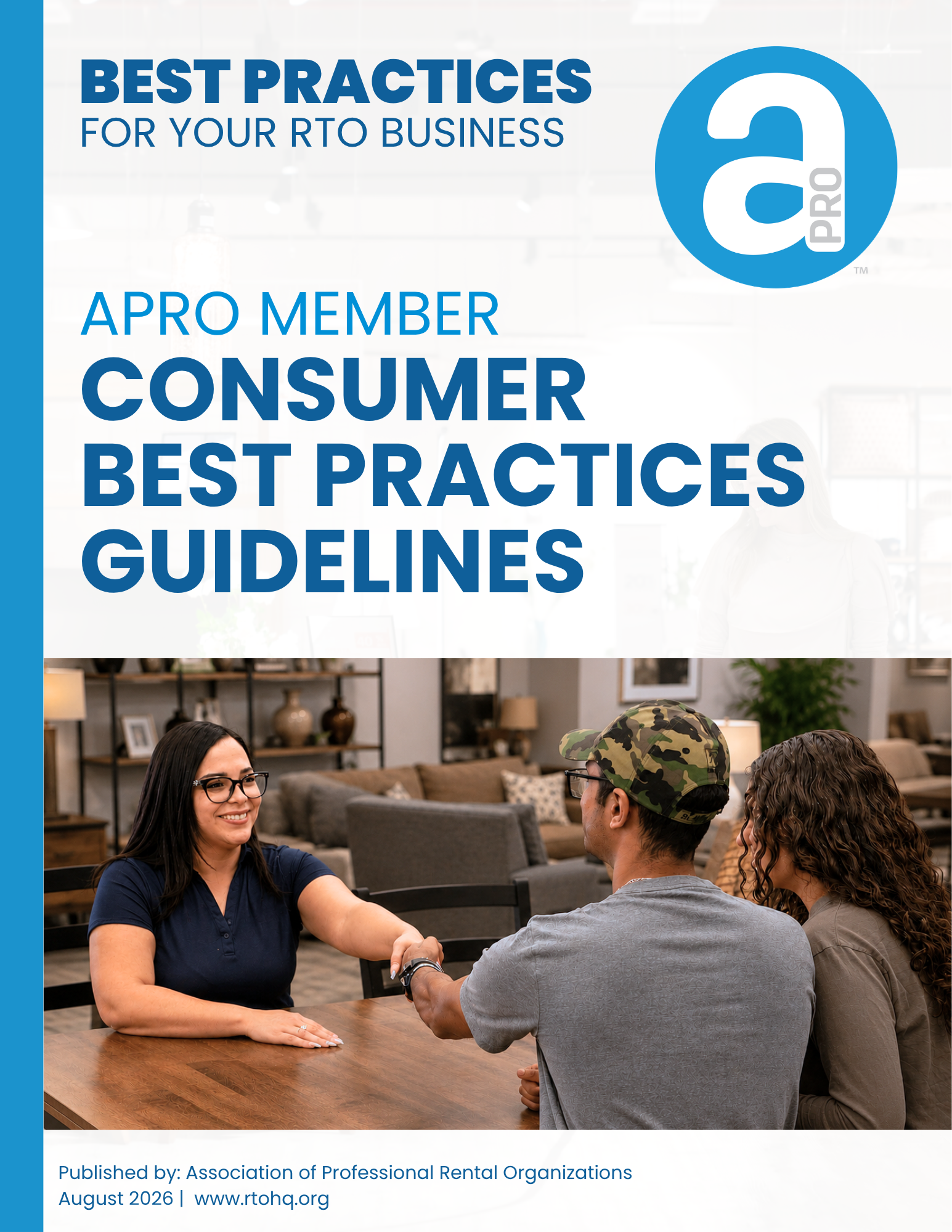
At the third annual Protecting the Transaction Legal Summit, held at RTO World, APRO introduced its new Member Consumer Best Practices Guidelines – the most substantial articulation to date of what the rent-to-own and lease-to-own industry expects of itself. The guidelines were the central topic of the Summit, and their release marked something larger than a document. It was APRO doing the work a trade association exists to do: setting the standard for its own industry, on its own terms, before anyone outside the industry does it first.
The guidelines reinforce a commitment that has defined the rent-to-own industry from its beginning. Improve the lives of consumers by delivering transparent lease-to-own solutions in compliance with the laws that govern the business.
That sentence sounds simple. Meeting it in practice, across a marketplace that now spans traditional storefronts, virtual lease-to-own at the point of sale, and third-party retail partnerships, requires far more than good intentions. It requires a shared understanding of what transparent actually means when a customer is standing at a counter or clicking through a checkout, and it requires operators across the industry to hold themselves to that understanding whether or not a specific statute compels them to.
What APRO’s Member Consumer Best Practices Guidelines Address
That is what these guidelines provide. They address:
- Advertising that is accurate and does not blur the line between lease-to-own and credit, because lease-to-own is a non-credit product and consumers deserve to understand it
- The prominent disclosure of the terms that matter most to a customer’s decision: the short initial lease term, the absence of any long-term obligation, the total cost to ownership if a customer chooses to renew through all optional renewal periods, and the right to return the merchandise at any time
- Giving customers time to inspect what they receive, limiting charges to what was disclosed and agreed, and training the third-party retail personnel who increasingly serve as the industry’s front line
The guidelines set general principles rather than legal requirements, and that is the point. They describe the conduct a responsible operator should adopt because it is right, not only because it is required.
Setting a Standard for a Changing Lease-to-Own Marketplace
This is what adaptation looks like for an industry that intends to endure. The regulatory environment is more active than it has ever been, with legislators and attorneys general across the country examining how lease-to-own is advertised, disclosed, and delivered.
The technology has changed, moving a growing share of the business online and into partnerships that did not exist a decade ago. And the industry’s oldest commitment – clear, honest disclosure – has not changed at all.
The guidelines hold those three things together. They take a longstanding principle and translate it into practice for a market that looks different than it used to.
Why Clear Disclosure Matters in Lease-to-Own
There is a reason disclosure carries such weight in this industry, and it goes to the nature of the transaction itself.
“Rent-to-own is more than a transaction. It is a relationship,” said APRO CEO Charles Smitherman. “In retail, after an exchange, the parties part ways. Lease-to-own is different. It involves multiple exchanges over time, with recurring lease renewals, and that structure raises the stakes on getting the beginning right.”
“When you are going to be in a relationship with a customer that may span many months, you owe them clear expectations from the very first conversation,” continues Smitherman. “Our job is to set customers up for success with terms that fit their individual needs and circumstances. These guidelines are how we make that commitment concrete across the entire industry.”
That distinction – a relationship rather than a one-time exchange – is why the industry cannot treat disclosure as a formality satisfied at signing. A customer who chooses to renew a lease month after month is making a series of decisions, and every one of them depends on having understood the terms clearly at the outset.
Establishing expectations early is not a compliance nicety. It is the foundation of a transaction that works for the customer, which is the only kind of transaction that works for the industry over time.
How APRO Helps the Industry Set Its Own Standards
APRO has served as the central hub of the rent-to-own industry for decades, and convening the industry around exactly this kind of shared standard is what that role means in practice. The association represents operators, manufacturers, suppliers, and service providers across all fifty states and internationally. It advocates for sound lease-to-own statutes, produces the education that trains the workforce, and brings the industry together at RTO World and at the Legal Summit.
Best practices of this kind are the through-line connecting all of it. They are the industry reasoning collectively about its own conduct and committing, in writing, to a standard it will hold itself to.
Self-regulation built with intention holds up better than regulation imposed from outside – in front of legislators, in litigation, and, most importantly, in front of the customer whose trust the entire business depends on. The Member Consumer Best Practices Guidelines are APRO promoting and protecting the industry in the most direct way available: by helping it be worthy of that trust.
The Guidelines that debuted at this year’s Summit are now available to the full membership, and the conversation they began at RTO World continues across the association’s work in the year ahead.
APRO Members can access the Consumer Best Practices Guidelines by logging into the Business Resource Hub.
Frequently Asked Questions
What are the APRO Member Consumer Best Practices Guidelines?
The APRO Member Consumer Best Practices Guidelines are a set of principles for the rent-to-own and lease-to-own industry, introduced by APRO at the third annual Protecting the Transaction Legal Summit. They reinforce the industry’s commitment to transparent lease-to-own solutions and cover accurate advertising, prominent disclosure of material terms including total cost to ownership, consumer inspection rights, limiting charges to disclosed amounts, and training of third-party retail personnel. The guidelines set general principles of responsible conduct rather than specific legal requirements.
What is the Protecting the Transaction Legal Summit?
The Protecting the Transaction Legal Summit is the rent-to-own industry’s premier annual gathering of legal and compliance professionals, hosted by APRO. Launched in 2024, the third annual Summit was held at RTO World, the annual industry convention. It brings together general counsel, compliance officers, regulatory specialists, and executives from traditional rent-to-own, virtual rent-to-own (VRTO), and lease-to-own (LTO) operators.
How is lease-to-own different from a retail transaction?
A retail transaction is a single exchange after which the parties part ways. Lease-to-own involves multiple exchanges over time through recurring optional lease renewals, creating an ongoing relationship between the operator and the customer. This structure heightens the need to establish clear expectations at the outset so customers understand the terms across the full life of the agreement and each optional renewal.
Is lease-to-own a credit or financing product?
No. Under well-established state laws, lease-to-own is a non-credit product, due largely to its short-term nature, its flexibility for consumers, and the customer’s ability to terminate the lease and return the merchandise at any time without penalty.
Who is APRO?
APRO, the Association of Professional Rental Organizations, is the national trade association for the rent-to-own industry, headquartered in Austin, Texas. It represents operators, manufacturers, suppliers, and service providers across all fifty states and internationally, and convenes the industry at events including RTO World and the Protecting the Transaction Legal Summit.