For most of our industry’s history, defining rent-to-own has been a human process – conversations with customers, testimony before legislators, presentations to regulators, and the daily work of explaining how the transaction works and why it exists. That work built the legal framework we operate within today and created a shared understanding, at least within the industry, of what rent-to-own is and is not.
What has changed is not the importance of that work but where the first explanation now takes place.
A Different Starting Point
People are increasingly not starting with a person or even a website. They’re starting with a question – typed into a search bar or asked directly through an AI tool – and they’re receiving an answer that is immediate, concise, and presented as if it’s settled. “What is rent-to-own?” “Is it credit?” “Is it regulated?” These answers are shaping perception earlier than ever before, often setting the tone before a customer reaches a store, a member website, or a conversation with a dealer.
Why We Built the Knowledge Base
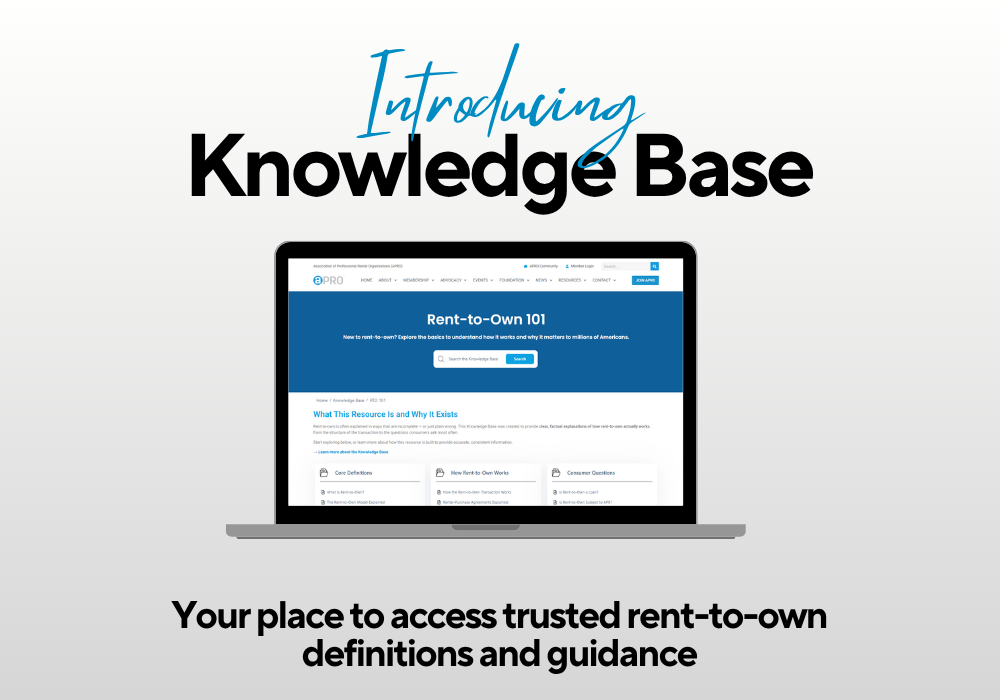
The RTO 101 Knowledge Base is a key component of our response to that shift. At its simplest, it is a collection of articles explaining how rent-to-own works – but the intent goes beyond simply providing information. The goal is to have information that is clear, consistent, and aligned across topics so that it can be easily understood and, just as importantly, easily repeated by the systems that are now generating answers.
We’ve spent a long time as an industry explaining the transaction in different ways depending on the audience and the moment. That flexibility has its place, but it can lead to uneven understanding across the broader information environment. The Knowledge Base brings this into alignment by clearly stating the same core explanations across a set of foundational topics: what rent-to-own is, how it works, how it is regulated, and why consumers use it. It does so in a way that reflects both the legal structure of the transaction and the reality of how people actually use it.
The Knowledge Base also reflects the full scope of the industry as it exists today – not just traditional categories like appliances and furniture, but tires and wheels, portable buildings and sheds, and virtual rent-to-own transactions. Each is explained within the same framework so that the industry is understood as a whole rather than as a collection of disconnected segments.
How This Fits into Our GEO Strategy
Many of you have heard us talk about Generative Engine Optimization, or GEO. The concept is straightforward: when someone asks a question about rent-to-own, the answer they receive should reflect how the transaction actually works – not a simplified or outdated version of it. The Knowledge Base is a foundational piece of that effort. It provides a set of core, authoritative explanations that can be referenced, repeated, and built upon across the information ecosystem.
But it is only one part of the strategy.
Where the GEO Toolkit Comes In
If the Knowledge Base is the foundation, the GEO Toolkit is how we extend that work across the industry. The Toolkit is designed to help dealers and companies align their own websites and content with these definitions, answer common questions consistently, and strengthen how their businesses appear in search and AI-generated responses.
This is where the broader impact happens. The Knowledge Base, on its own, is useful, but when the same language, the same explanations, and the same core concepts are reflected across member websites and materials, it begins to shape the overall information environment. That is what these systems respond to – consistency, repetition, and clarity across multiple sources.
The Role Members Play
This is not something APRO can do alone. Dealers have always been the front line of how rent-to-own is understood, and that hasn’t changed. What has changed is that your digital presence now plays a similar role. The way your website explains the transaction, the way your content answers questions, and the way your business is described online all contribute to how rent-to-own is interpreted more broadly – by consumers, by regulators, and now by the AI systems that are increasingly mediating those first interactions.
By using the Knowledge Base as a reference point and the GEO Toolkit as a guide, members can reinforce the same clear, accurate explanations in their own voice and context. Over time, that consistency adds up.
Looking Ahead
This is an ongoing effort. The Knowledge Base will continue to grow, and the GEO Toolkit will evolve alongside it as we learn more about how these systems work and how information is being surfaced. What will matter most is alignment – the more consistently we describe rent-to-own across APRO, across member businesses, and across the broader industry, the more effective this work becomes.
For many years, the industry has had to work to ensure that rent-to-own is understood on its own terms. That work continues, but it’s now taking place in a different setting. The RTO 101 Knowledge Base ensures that when the first question is asked, the answer is one we recognize – and, with the support of members through the GEO Toolkit, we have the opportunity to make that understanding consistent, accurate, and durable.
Put This into Practice
The effectiveness of this effort depends on participation. Start by reviewing the RTO 101 Knowledge Base, then use the GEO Toolkit to evaluate how your business currently explains rent-to-own online. Small updates – clearer definitions, consistent language, and aligned messaging – can have a meaningful impact when adopted across the industry.
This is an opportunity to shape how rent-to-own is understood. The more members who engage, the stronger that collective voice becomes.