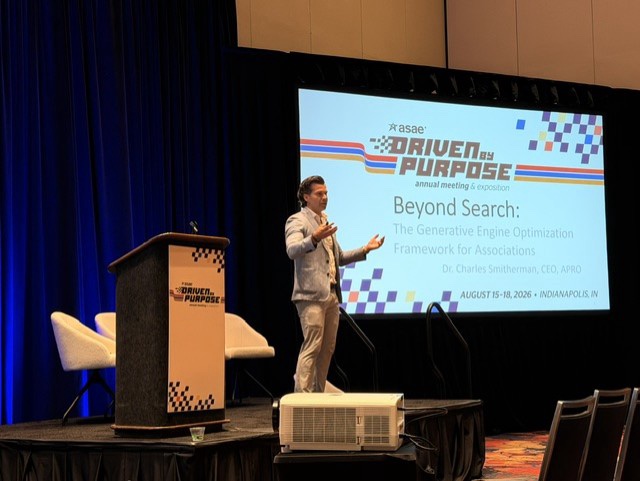
APRO CEO Charles Smitherman brought the association’s work on artificial intelligence, Generative Engine Optimization (GEO), and knowledge stewardship to a national audience of association leaders at the 2026 American Society of Association Executives (ASAE) Annual Meeting & Exposition, held August 15-18 in Indianapolis, Indiana.
Smitherman’s session, “Beyond Search: The Generative Engine Optimization Framework for Associations,” challenged associations to rethink what it means to serve as the authoritative voice of a profession or industry when people increasingly receive information through generative AI rather than traditional search results.
The topic is one APRO knows through firsthand experience. Smitherman’s presentation drew on the strategy behind APRO’s Generative Knowledge Initiative, which was recently recognized with a 2026 ASAE Power of Associations Award. The national award honors association programs that create measurable impact for their industries or communities and recognized APRO’s work to build a stronger, more authoritative public knowledge record for the rent-to-own (RTO) industry.
The connection between the award and the ASAE presentation is significant: APRO is not only implementing a new approach to digital advocacy within rent-to-own. Its experience is now being shared as a model for other associations navigating the same shift.
When Search Becomes Answers
For years, organizations approached digital authority largely through search engine optimization (SEO): publish useful information, make it discoverable, and improve the likelihood that people will find the organization’s website.
Generative AI changes that path.
A person can now ask ChatGPT, Gemini, Google AI, Claude, Perplexity, or another AI system a question about an industry and receive a synthesized answer without visiting the websites behind it. The sources an AI system uses may also differ substantially depending on the question and how it is phrased.
That changes the central question for associations.
As Smitherman framed it: “When AI answers the question, are we helping shape the answer?”
Generative Engine Optimization (GEO) addresses that challenge. GEO is the practice of making authoritative information clear, accessible, structured, connected, and credible enough that generative AI systems can find it, understand it, and use it when producing answers.
For associations, however, Smitherman argues that GEO belongs within a larger discipline: knowledge stewardship.
Associations have always created and preserved the knowledge of their fields through standards, definitions, research, education, policy positions, historical records, expert voices, and institutional memory. AI has not changed that responsibility. It has changed the environment in which that responsibility must be carried out.
An inaccurate AI explanation of an industry, Smitherman told attendees, is therefore more than a marketing problem. It is a stewardship problem.
APRO Became Its Own Case Study
Smitherman used APRO’s experience to demonstrate what that looks like in practice.
When APRO began examining how AI systems understood the association and rent-to-own, it found basic gaps. AI systems could confuse APRO with other organizations using the same acronym, rely on outdated information about the association, misclassify the rent-to-own industry, or repeat familiar criticisms without sufficient industry context.
At the same time, much of APRO’s strongest information was difficult for AI systems to use. Decades of industry history and expertise existed in magazine PDFs, archives, legacy materials, and resources never designed for an AI-mediated information environment.
APRO began rebuilding that foundation.
The Generative Knowledge Initiative has included the RTO 101 Knowledge Base, RTO Insight Review, the RTO Legends oral-history project, support for The Rent-to-Own Revolution, more than 3,000 digitized historical magazine articles, expanded industry data and analysis, and the GEO Toolkit developed to help APRO members strengthen their own digital authority.
The strategy also changed how APRO publishes. Important knowledge is increasingly made available in crawlable, accessible formats rather than remaining isolated in PDFs or behind digital walls. Content can serve the human reader through strong reporting, narrative, expertise, and context while also giving AI systems clearer summaries, terminology, metadata, FAQs, and connections among authoritative resources.
The work is producing measurable results. APRO now reports more than 1.1 million search impressions and has become the most-cited domain in its category, ahead of sources including Reddit, YouTube, and Wikipedia. APRO content is also appearing prominently in answers generated by platforms including ChatGPT, Google AI, and Gemini. National media campaigns have generated more than 1,600 placements with a potential audience exceeding 460 million people.
Those results helped earn APRO the 2026 ASAE Power of Associations Award for the Generative Knowledge Initiative and demonstrate that the rent-to-own industry is becoming a stronger source for information about itself.
A Practical Framework for Association Knowledge Stewardship
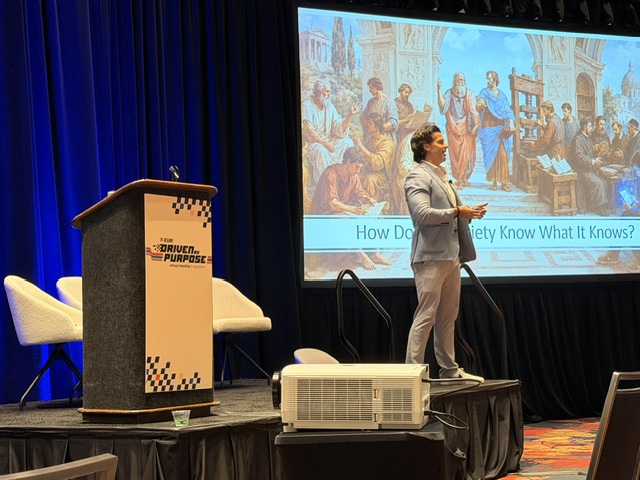
Smitherman’s ASAE presentation translated APRO’s experience into a practical approach other associations can use to evaluate and strengthen how their expertise appears in AI-generated answers.
Rather than treating GEO as a one-time technology project, Smitherman framed it as an ongoing knowledge stewardship responsibility. His presentation encouraged associations to assess what AI currently says about their field, identify gaps or inaccuracies, make authoritative knowledge more accessible, strengthen the external sources AI uses to validate information, and assign clear responsibility for maintaining that work over time.
The larger point was straightforward: Associations already possess deep expertise and institutional authority. The challenge is making sure that authority is visible and usable in the systems increasingly shaping how people learn about their professions and industries.
The Conversation Continues Beyond the Session
Approximately 80 people attended Smitherman’s ASAE session. Many remained afterward to continue the discussion and ask questions, and multiple attendees approached him about presenting the topic to their own groups.
The response reflects the broader challenge facing associations. Organizations across industries are confronting the same question APRO began addressing within rent-to-own: What happens when an institution possesses deep expertise, but the systems answering the public’s questions do not know how to find or interpret it?
Smitherman’s answer is not that associations need to chase every new AI platform or abandon the communications practices that already work.
They need to treat their knowledge as an asset.
“We’re all stewards here,” Smitherman told attendees. “We’ve inherited something that we want to live past us.”
That idea also separates APRO’s initiative from a conventional technology project. GEO involves websites and AI systems, but the underlying work is about institutional authority, accuracy, history, expertise, and responsibility.
What It Means for Rent-to-Own
For APRO members, the ASAE presentation offers another measure of what the association’s Generative Knowledge Initiative is accomplishing.
APRO’s advocacy has always included helping policymakers, media, consumers, and other audiences understand rent-to-own accurately. Today, some of those audiences may encounter the industry first through an AI-generated answer, making the information available to those systems part of the advocacy environment.
A policymaker researching rental-purchase regulation, a journalist learning about the industry, a consumer comparing options, or a prospective employee asking how rent-to-own works may all rely on information synthesized by AI. APRO’s goal is to ensure accurate, authoritative industry knowledge is available when those answers are generated.
Members can strengthen that effort as well. Clear explanations of rent-to-own on company websites, accurate business information, credible media coverage, authentic customer and community stories, and links to authoritative industry resources all contribute to a stronger public information record.
The GEO Toolkit was created to help APRO members begin that work within their own organizations.
APRO’s experience has now earned national recognition and a place on the education program at ASAE’s largest annual gathering. Together, the 2026 Power of Associations Award and Smitherman’s presentation demonstrate how work developed to strengthen the rent-to-own industry’s digital authority is contributing to a much broader conversation about the role of associations in the age of AI.
For APRO, that work remains rooted in advocacy. As consumers, policymakers, journalists, and other audiences increasingly turn to AI for information, ensuring that accurate, authoritative rent-to-own knowledge is part of the public record becomes another way to promote and protect the industry.
By sharing APRO’s experience with association leaders nationwide, Smitherman is extending that impact beyond rent-to-own and positioning APRO as an early voice in how associations can preserve their expertise and authority as the way people find information continues to change.