
By Justin B. Hosie and K. Dailey Wilson
Hudson Cook, LLP | APRO Member
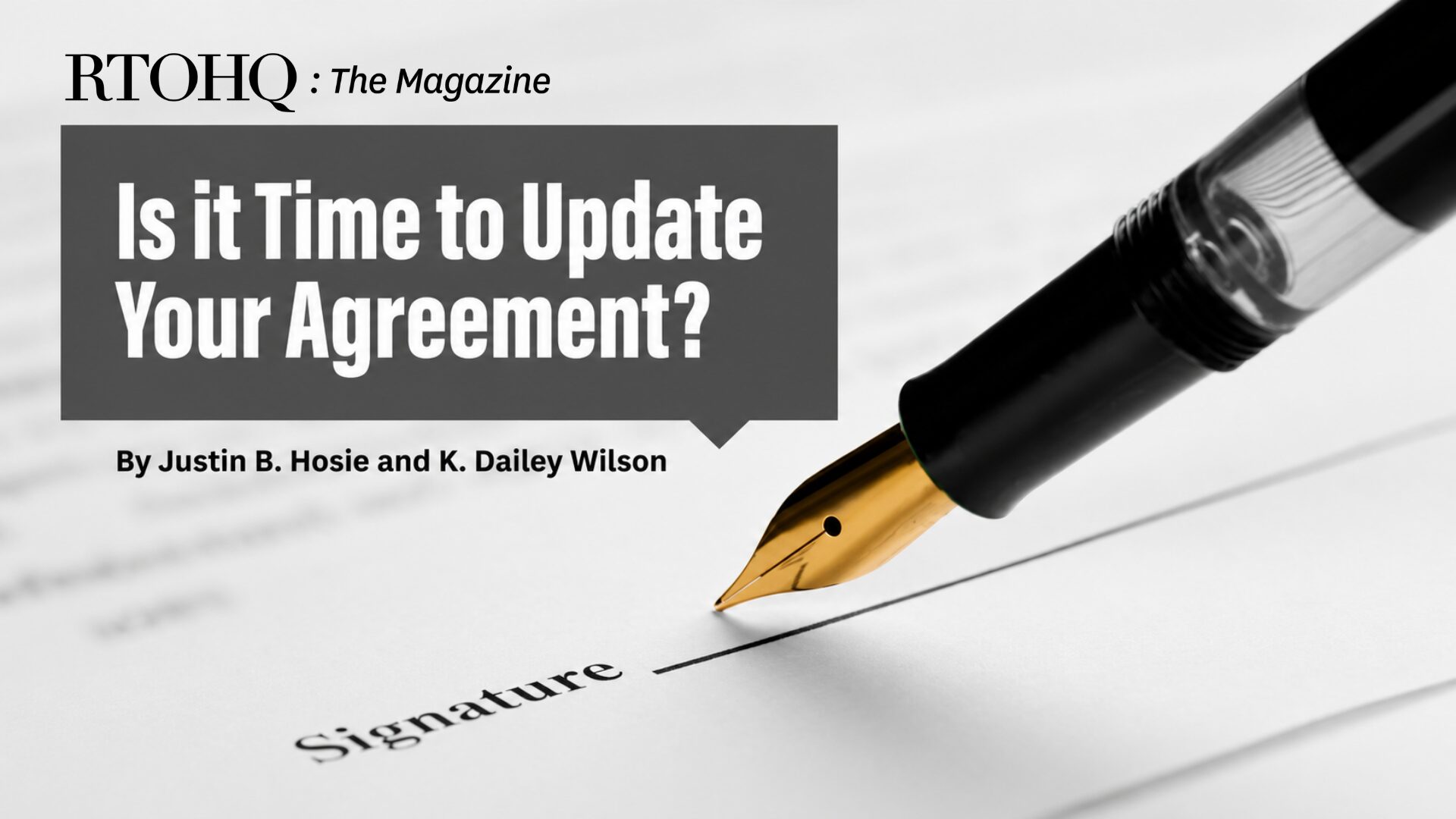
When is the last time you updated your rental-purchase agreement?
A year ago? Two years ago? Five years ago? If you had to stop and think about it, you’re not alone. But that pause is exactly the point. Consumer-facing documentation is not something that can sit on a shelf. It should be reviewed – and often updated – on at least an annual basis. Even when the underlying state rent-to-own statute remains unchanged, the legal environment around that statute rarely stands still.
Courts reinterpret provisions. Regulators shift priorities. Adjacent areas of law – particularly arbitration, electronic contracting, and consumer communications – continue to evolve in ways that directly affect how your agreement functions in practice. In other words, the law is not static. And your agreement shouldn’t be either.
For many operators, the rental-purchase agreement is treated as a formality – a document that must be signed to complete the transaction. In reality, it is far more than that. It is the legal backbone of your business model and the primary way your compliance posture is communicated to regulators, courts, and consumers alike. A well-structured agreement reflects compliance with applicable state RTO/LTO statutes, incorporates evolving legal standards beyond the statute itself, clearly communicates rights and obligations to the consumer, and protects the business in the event of disputes or litigation. An outdated agreement, by contrast, can quietly introduce risk. Not necessarily because it violates the law outright, but because it fails to reflect how the law is currently interpreted or enforced. That distinction is where many compliance issues arise.
Two Practical Paths to Updating Your Agreement
You do have a couple of options in terms of having your agreements updated. First, you could engage an attorney to review your existing agreement and suggest any changes. As noted above, these revisions may be driven by changes in statutory law, evolving interpretations of rent-to-own regulations, or developments in related areas such as arbitration, electronic signatures, and consumer consent requirements. This approach can be particularly effective if you already have a strong foundational agreement that was originally drafted with legal guidance and requires only targeted updates. For many operators, this is a practical and familiar path.
Alternatively, you can take advantage of APRO’s new RTO/LTO Model Lease Agreement Library. APRO engaged the authors of this article to develop a comprehensive library of lease agreements designed to comply with applicable state RTO/LTO laws and to incorporate key provisions such as arbitration clauses.
This is not simply a template bank. It is a structured, evolving resource designed to help members navigate a complex, multi-state legal environment with greater confidence and consistency. Members can obtain these templates by entering into a limited attorney-client engagement with the authors, allowing for tailored guidance based on the member’s specific operations and jurisdiction.
That engagement ensures that the agreement is not just technically compliant, but also aligned with how your business actually operates. Additionally, members have the opportunity to discuss the merits of developing and providing ancillary disclosures to address broader compliance considerations, including payment authorizations, communication consent for calls, texts, and emails, E-Sign agreements, arbitration disclosures, and product-specific requirements.
In practice, these ancillary disclosures are where many compliance gaps exist – not because they are ignored, but because they evolve quickly and are often treated separately from the core lease agreement.
Why This Matters Now
The introduction of a centralized, state-by-state lease agreement library comes at a particularly important moment for the industry. Regulatory expectations around clarity, transparency, and documentation continue to rise. The standard is no longer simply whether an agreement complies with the statute as written, but whether it reflects best practices in disclosure, consent, and consumer communication. At the same time, the operational landscape is becoming more complex. Businesses are expanding into new product categories and adopting new technologies such as e-sign platforms and digital communication tools. Each of these developments introduces additional considerations that must be reflected in the agreement structure. A one-size-fits-all, legacy document is increasingly difficult to sustain in that environment.
Either approach – updating your existing agreement through counsel or utilizing the APRO Model Lease Agreement Library – is a valid way to move forward. The right choice will depend on your specific circumstances. Points to consider when deciding on the best updating method include whether your existing lease agreement has been updated or drafted within the last couple of years, whether your current agreement includes ancillary disclosures such as payment authorizations, communication consent, and E-Sign agreements, whether your existing agreement was originally drafted by an attorney, and whether your business operations are unique, requiring customized provisions for items such as convenience fees, calling or texting authorizations, electronic signatures, or specialized product categories like tires or mobile phones. For some operators, the existing agreement will provide a solid foundation that simply needs refinement. For others – particularly those operating across multiple jurisdictions or expanding into new categories – the opportunity to leverage a comprehensive, state-specific library may offer a more efficient and scalable solution.
The Value of Consistency
One additional benefit of utilizing a centralized resource like the APRO library is consistency. Across the industry, lease agreements have historically developed in a fragmented way – different formats, different terminology, different approaches to disclosures. While each agreement may have been individually compliant, the lack of consistency can create challenges in training, operations, and regulatory perception. A more standardized approach does not eliminate flexibility. Instead, it creates a clearer baseline – a shared framework that reflects how the industry defines and delivers the rental-purchase transaction. That consistency strengthens internal processes, supports employee training, and reinforces credibility with regulators and consumers alike.
Whether you decide to use the APRO library or engage counsel to review your existing agreement, the most important takeaway is straightforward: review your agreement regularly. Not occasionally. Not only when a problem arises. But as part of your ongoing business operations.
Because the risks associated with outdated documentation are rarely obvious in the moment. They tend to surface later – during a dispute, an audit, or a regulatory inquiry – when the cost of correction is significantly higher. A proactive review, by contrast, is relatively simple and places your business in a far stronger position moving forward.
Top 5 Risks of an Outdated Lease Agreement
Misalignment with Current Law
Even if statutes haven’t changed, interpretations often have. Courts and regulators may view provisions differently than when your agreement was drafted.
Gaps in Consumer Disclosures
Missing or outdated disclosures – particularly around communication consent or electronic signatures – can create compliance vulnerabilities.
Arbitration and Enforcement Issues
Arbitration clauses are frequently challenged. Language that was enforceable a few years ago may no longer hold up.
Operational Mismatch
Your business may have evolved – new products, new fees, new processes – but your agreement hasn’t kept pace.
Increased Litigation and Regulatory Risk
Outdated agreements don’t usually fail quietly. They tend to surface during disputes, audits, or enforcement actions – when stakes are highest.
Final Thought
The rental-purchase transaction has always been defined by its flexibility and responsiveness to consumer needs. It is only fitting that the agreements governing that transaction reflect the same adaptability. The tools now exist – whether through individual legal review or through APRO’s Model Lease Agreement Library – to ensure that your documentation keeps pace with the law and with your business. The only question is whether you are taking advantage of them.
Justin B. Hosie and K. Dailey Wilson are Partners with Hudson Cook, LLP.