

Artificial intelligence is no longer something happening on the horizon. It is already reshaping how businesses communicate with customers, market their products, manage operations, and make decisions. Whether through tools like ChatGPT, Copilot, Gemini, and Claude, or through vendor-provided customer service, collections, and marketing platforms, AI is becoming increasingly common throughout the rent-to-own industry.
Just a year ago, only a small percentage of APRO members reported actively using AI tools. Today, adoption is growing rapidly, and many industry vendors are incorporating AI-powered capabilities into their products and services. Over the next several years, AI will likely become a standard part of doing business for many rent-to-own companies.
That reality creates both opportunity and responsibility.
Used thoughtfully, AI can help businesses improve efficiency, support employees, enhance customer communication, and streamline repetitive tasks. Used carelessly, it can create compliance concerns, customer trust issues, data privacy risks, and operational challenges.
Recognizing both the promise and the potential pitfalls of these technologies, APRO has developed a new suite of member resources designed specifically for the rent-to-own industry. Rather than focusing on technology for technology’s sake, these resources are intended to help members understand where AI fits into their businesses, how to adopt it responsibly, and how to protect the relationships and values that have long defined successful RTO operations.
Why APRO Developed These Resources
One of the challenges facing businesses today is that AI is evolving much faster than many organizations can reasonably keep pace with. New tools appear almost weekly. Vendors are rapidly incorporating AI capabilities into existing platforms. Employees are increasingly experimenting with publicly available AI tools, often without formal guidance or training.
For many business owners and managers, the question is no longer whether AI exists. The question is how to use it responsibly.
As the national trade association for the rent-to-own industry, APRO believes it is important to help members navigate these changes proactively rather than reactively. Our goal is not to encourage blind adoption of every new technology. Nor is it to discourage innovation. Instead, we seek to provide practical guidance that helps businesses make informed decisions while maintaining compliance, protecting customer information, and preserving the personal service that remains at the heart of the rent-to-own transaction.
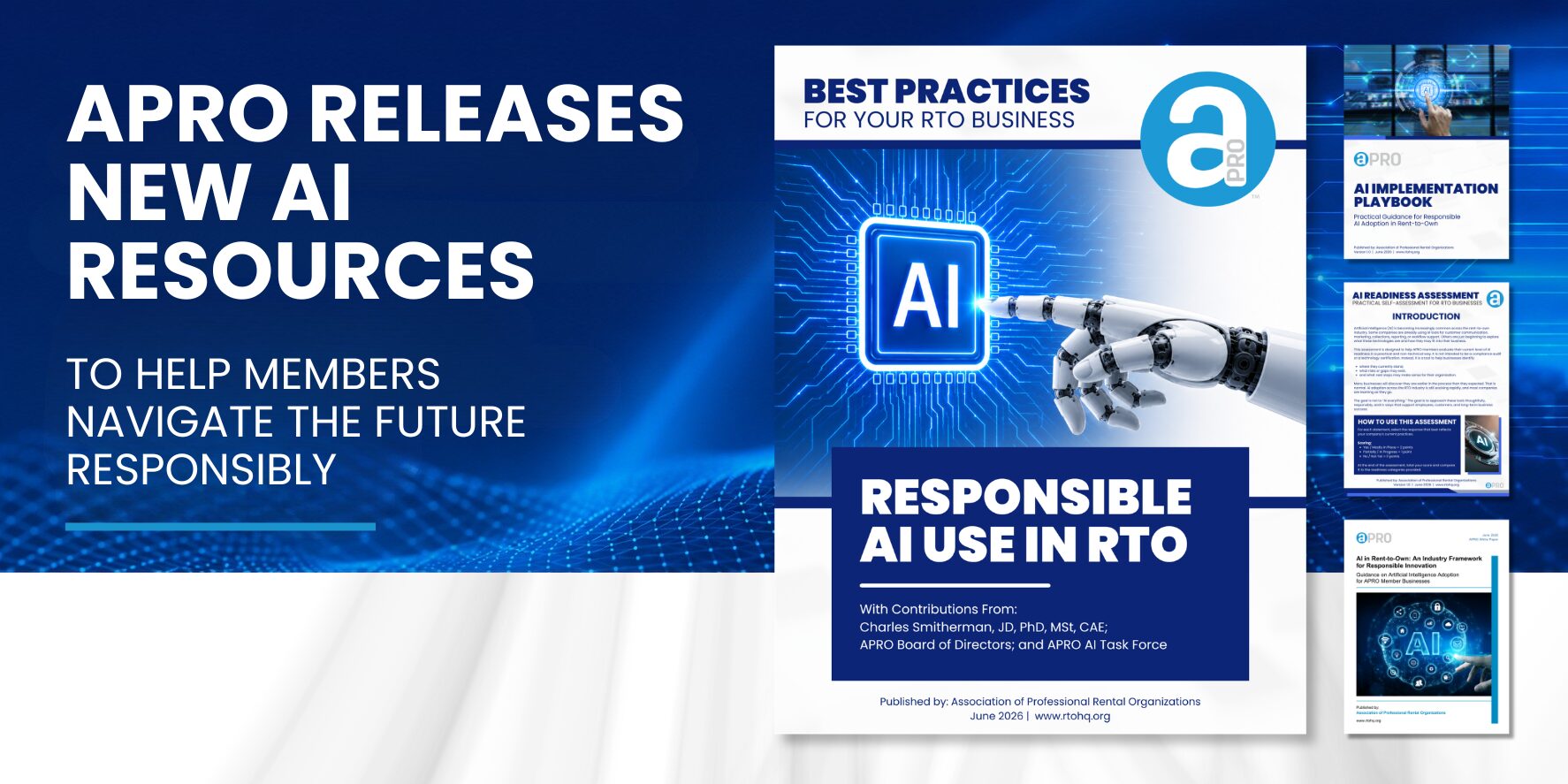
To support that effort, APRO has developed four complementary resources that work together as a practical AI implementation toolkit for member companies.
Resource #1: APRO AI White Paper
The foundation of the new toolkit is the APRO AI White Paper, a comprehensive guide to understanding artificial intelligence in the context of rent-to-own operations.
The white paper explains what AI is, how it works, and where members are most likely to encounter it in their businesses. It addresses topics such as customer communications, employee use of AI tools, vendor relationships, data privacy, human oversight, AI voice technologies, compliance considerations, and emerging operational risks.
Most importantly, the white paper places AI within the unique context of the rent-to-own industry. It recognizes that successful RTO businesses are built on customer relationships, trust, flexibility, and service. While AI can be a valuable tool, it cannot replace the human judgment and accountability that remain central to serving customers effectively.
The white paper is designed for business owners, executives, managers, and anyone seeking a deeper understanding of responsible AI adoption.
Resource #2: APRO AI Best Practices Guide
While the white paper provides the broader framework, the APRO AI Best Practices Guide focuses on practical recommendations that members can apply immediately.
The guide outlines clear principles for responsible AI use, including:
- Transparency in customer communications
- Maintaining human oversight
- Protecting customer information
- Reviewing AI-generated content for accuracy
- Using AI in compliance-sensitive situations carefully
- Evaluating vendors thoughtfully
- Training employees appropriately
The document is written in plain language and is intended to help businesses establish reasonable guardrails without becoming overly technical or burdensome.
Many members are still in the early stages of AI adoption. The Best Practices Guide provides a practical roadmap for businesses looking to take advantage of these tools while avoiding common mistakes.
Resource #3: APRO AI Readiness Assessment
Knowing where to start is often the most difficult part of adopting any new technology.
The APRO AI Readiness Assessment is designed to help businesses evaluate their current level of preparedness. Through a series of practical questions, members can assess areas such as:
- Leadership readiness
- Employee awareness and training
- Customer communication practices
- Data privacy safeguards
- Vendor management
- Compliance considerations
- Ongoing monitoring and oversight
The assessment is not intended as a compliance audit or certification. Instead, it serves as a practical self-evaluation tool that helps businesses identify strengths, uncover gaps, and prioritize next steps.
For many companies, this may become the most useful resource in the toolkit because it helps translate broad concepts into concrete action items.
Resource #4: APRO AI Implementation Playbook
Understanding AI and assessing readiness are important first steps, but many businesses still face a practical question: “What do we actually do next?”
The APRO AI Implementation Playbook was developed to answer that question.
Designed as a practical companion to the White Paper, Best Practices Guide, and Readiness Assessment, the Playbook provides straightforward guidance for businesses that are ready to begin using AI tools or expand their existing efforts. Rather than focusing on technical details, the Playbook emphasizes practical implementation strategies that can be applied by businesses of all sizes.
The Playbook helps members identify appropriate starting points, understand where additional caution may be needed, and establish reasonable guardrails before introducing AI into customer-facing or operational workflows.
Topics include:
- Low-risk ways to begin using AI within an RTO business
- Maintaining human oversight and accountability
- Protecting customer information
- Evaluating AI vendors and service providers
- Using AI responsibly in customer communications
- Recognizing and reviewing AI-generated errors
- Establishing simple oversight and monitoring practices
The Playbook also includes practical tools, checklists, and implementation exercises designed to help members move from theory to action. Whether a company is just beginning to explore AI or is already testing new technologies, the Playbook provides a practical roadmap for responsible adoption.
Perhaps most importantly, the Playbook reinforces a core message that appears throughout APRO’s AI resources: successful AI adoption is not about replacing employees or automating every process. It is about using technology thoughtfully to strengthen operations, support employees, and improve service while preserving the trust and relationships that remain central to the rent-to-own industry.
A Practical Approach to AI
One of the consistent themes throughout all four resources is that businesses do not need to become technology companies to use AI successfully.
In fact, many of the most valuable uses of AI today are relatively simple. Drafting emails, summarizing meetings, organizing training materials, generating marketing ideas, and improving workflow efficiency are often excellent starting points.
At the same time, businesses should approach higher-risk applications more cautiously. Collections communications, AI voice systems, customer disputes, hardship situations, pricing decisions, and compliance-sensitive activities often require additional oversight and human involvement.
The goal is not to automate everything. The goal is to use technology in ways that strengthen operations without weakening customer relationships.
Looking Ahead
Artificial intelligence will continue evolving, and so will the rent-to-own industry’s use of these technologies. APRO intends for these resources to serve as a foundation for ongoing education, discussion, and industry leadership.
As members gain experience, identify emerging challenges, and develop successful implementation strategies, APRO will continue updating guidance and sharing best practices across the industry.
The rent-to-own industry has always adapted to changing customer needs, economic conditions, and technological developments. AI represents another step in that evolution.
The companies that benefit most will likely not be those that adopt every new tool first. They will be the companies that remain focused on what has always mattered: serving customers well, operatingresponsibly, and building trust over time.
APRO’s new AI resources are designed to help members do exactly that.

