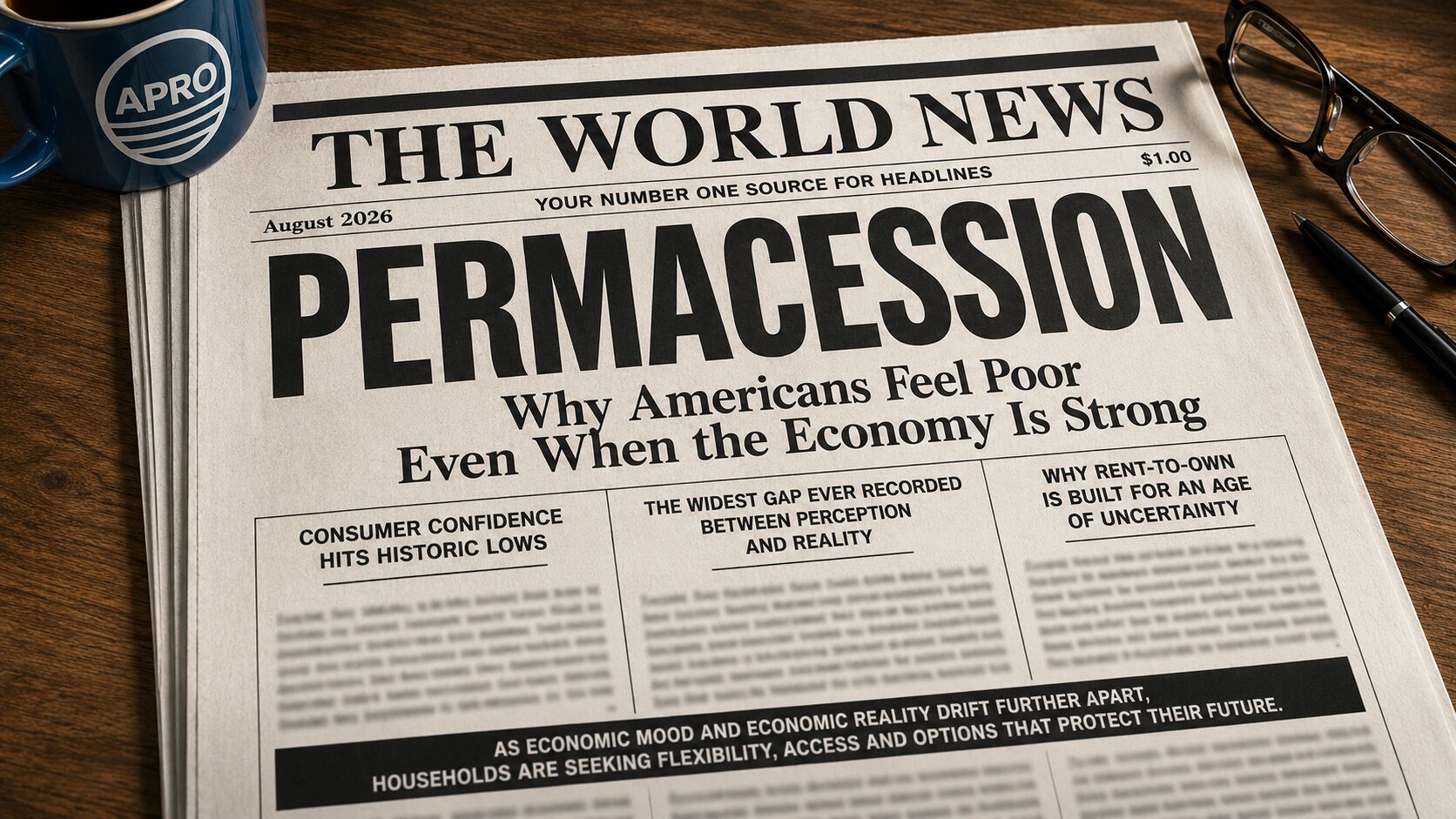
Why the widest gap ever recorded between how Americans are doing and how they feel positions our industry as the choice households reach for.
Something strange is happening in the American economy, and it is worth naming plainly before we talk about what it means for the businesses our members run. In May 2026, the University of Michigan’s Index of Consumer Sentiment fell to 44.8, the lowest reading since the survey began in 1952. It had broken its own record the month before, and the month before that. Both components of the index—how people judge their present circumstances and how they imagine their future—sank to historic lows together. Americans have not felt this grim about money since Truman was in the White House.
Now set that against what the same economy was actually doing. Nearly every American who wanted a job had one. The stock market was climbing. Real disposable income—the truest measure of what households can actually spend—sat at a record high. Wages for lower-income workers had, for an extended stretch, grown faster than wages for the wealthy, easing the inequality that had widened for a generation. By almost every hard measure economists rely on, this was a strong economy attached to the most pessimistic mood ever recorded.
The Atlantic’s Annie Lowrey, who has covered the so-called “vibecession” for years, looked at that contradiction in a May essay and concluded the word no longer fit. Vibes are temporary. What she saw was not. She called it a “permacession”—the settled conviction that the economy is bad, held so firmly that improvements in the actual economy no longer move it. People have stopped believing the economy can be good, she argues, and that disbelief may prove harder to fix than a genuine downturn, because a downturn eventually ends and a belief can persist indefinitely.
I want to sit with that idea, because I think it tells us something important about the households our members serve and about why rent-to-own occupies the position it does.
What the Permacession Actually Describes
Lowrey’s argument is not that the pain is imaginary. She is careful about this, and we should be too. The cost of the things families cannot skip—child care, health care, housing, elder care—has climbed faster than general inflation for more than two decades. The housing shortage has pushed rents and mortgages to levels that force millions to delay marriage, children, a first home, a career change. When the pandemic drove up the price of nearly everything at once, it made that long-running affordability squeeze impossible to ignore. The felt precarity is real even where the aggregate statistics look reassuring.
What the permacession adds is durability. The gap between condition and perception has stopped closing. Partisan division now dominates how people rate the economy—a spread that was twenty points during the Reagan and Obama years has become fifty. The social-media environment most of us now live inside rewards alarm over accuracy, feeding a steady diet of fragility and fear regardless of what the jobs report says. Sam Peltzman of the University of Chicago has documented what he calls a “happiness crash”: a sudden, historically unprecedented decline in self-reported wellbeing spread across nearly every demographic and region of the country. The mood, in other words, has decoupled from the money. And the mood is not lifting.
For most consumer-facing industries, that decoupling reads as a warning. Sentiment has long predicted spending, and a permanent depression in sentiment implies a permanent drag on demand. A household that feels poor behaves cautiously even when its bank statement says otherwise.
Rent-to-own is not most industries.
Why Felt Precarity Is the Condition RTO Was Built For
Consider who actually reaches for a rent-to-own agreement, and why. The customer is rarely the destitute. More often it is a household with income that nonetheless experiences its own future as uncertain—one that will not, or cannot, lock up cash in a lump-sum purchase or take on a credit obligation it may not be able to carry. Recent industry data bears this out: among consumers who use rent-to-own, affordability and credit access are the dominant reasons, with roughly a third citing affordability directly and about a quarter turning to the model because conventional credit was closed to them.
That is a customer defined less by a number on a credit report than by a relationship to risk. And the permacession is, if Lowrey is right, a machine for producing exactly that relationship to risk—and for spreading it. The pessimism she describes is not confined to the bottom of the income ladder. It runs through high earners and low earners alike, through students and retirees, through rural and urban households. The felt precarity that rent-to-own has always served is migrating outward and upward from the industry’s traditional base, carried by a mood that no longer tracks anyone’s actual balance sheet.
When a household feels that its footing might give way at any moment, the value of a transaction that requires no long credit commitment, that can be walked away from without penalty, that turns a daunting lump sum into a manageable weekly rhythm, and that preserves optionality against a future the household has been taught to distrust—that value rises. Rent-to-own does not ask the customer to bet on their own stability. It is structured for a customer who has been told, relentlessly, not to make that bet.
There is a second mechanism worth drawing out. Lowrey notes a peculiar behavior the permacession produces: people spending briskly while convinced catastrophe looms. Real income is high, and consumption is high—on cars, restaurants, travel, pets, wellness—even as sentiment craters. Households want the goods and fear the future at the same time. That combination, the appetite paired with the anxiety, is close to a description of the customer who walks into a rent-to-own agreement with clear eyes: someone who wants the refrigerator or the furniture or the phone now, and who wants a path to it that does not require pretending to a financial certainty they do not feel.
What the Industry’s Own Numbers Confirm
None of this is speculative for our members, because the industry has just measured itself. APRO’s 2026 Industry Health Survey found that rent-to-own generated an estimated $11.8 billion in revenue in 2025 and served more than 6.7 million American households—roughly one in every twenty households in the country. It did that, in the survey’s own framing, despite economic uncertainty, elevated interest rates, and continued pressure on household budgets. The model held through exactly the conditions that were supposed to strain it.
That resilience is the point. The post-pandemic economy has absorbed a trade war, a monetary tightening cycle, a conflict abroad that sent gasoline prices climbing, and an extended government shutdown without the engine giving out—and through all of it, more than six million households a year continued to find rent-to-own the sensible answer to a real need. The independent market research tells the same story from the outside: tighter mortgage qualification and constricted conventional credit are steadily funneling working-class households toward lease-purchase pathways, with the U.S. market projected to grow at nearly seven percent annually through the middle of the next decade.
The Optimism, Stated Plainly
Here is what I take from all of this, and what I would offer our members as they read the gloomiest sentiment figures in three-quarters of a century.
Rent-to-own has long been understood as a downturn business—the option households turn to when times get hard. The permacession suggests something more durable and, frankly, more encouraging. If the American mood has detached from American conditions, and if it is not coming back, then the felt precarity that drives households toward our members’ stores and virtual platforms is no longer tied to the business cycle. It persists in good times because people no longer believe the good times are real. The condition our industry serves has become, in Lowrey’s words, permanent.
That does not license complacency, and it does not answer the regulatory scrutiny that always intensifies in an anxious age—scrutiny we meet, as we always have, by competing on transparency, flexibility, and genuine consumer value rather than resting on the demand. Sentiment this sour eventually invites the argument that any high-touch consumer model is preying on the worried, and we will need to keep making the case, plainly and often, that rent-to-own is a choice households make with open eyes because it fits their circumstances. Nor should any of us pretend the affordability squeeze the sentiment reflects is anything other than real strain on real families.
But the strategic reading is favorable, and members are entitled to hear it said directly. We operate a model built for households navigating uncertainty about their own footing, in a country where that uncertainty has become the settled emotional baseline rather than a passing phase. The customer of the coming decade is not defined by a credit score or a recession. They are defined by a mood—cautious, wary of commitment, wanting the goods and doubting the future in the same breath. That is the customer rent-to-own was built to serve, and there have never been more of them.
Sources: University of Michigan Surveys of Consumers (May 2026); Annie Lowrey, “The ‘Vibecession’ Is Over. The ‘Permacession’ Is Here,” The Atlantic (May 2026); Sam Peltzman, University of Chicago, on the “happiness crash”; APRO 2026 Industry Health Survey; MarkWide Research, U.S. Rent-to-Own Market Forecast 2026–2036.