For a family whose refrigerator breaks days before payday, replacing an essential appliance can quickly become more than a shopping decision. Food needs to stay cold. Medicine may need refrigeration. Daily life does not wait for the next paycheck.
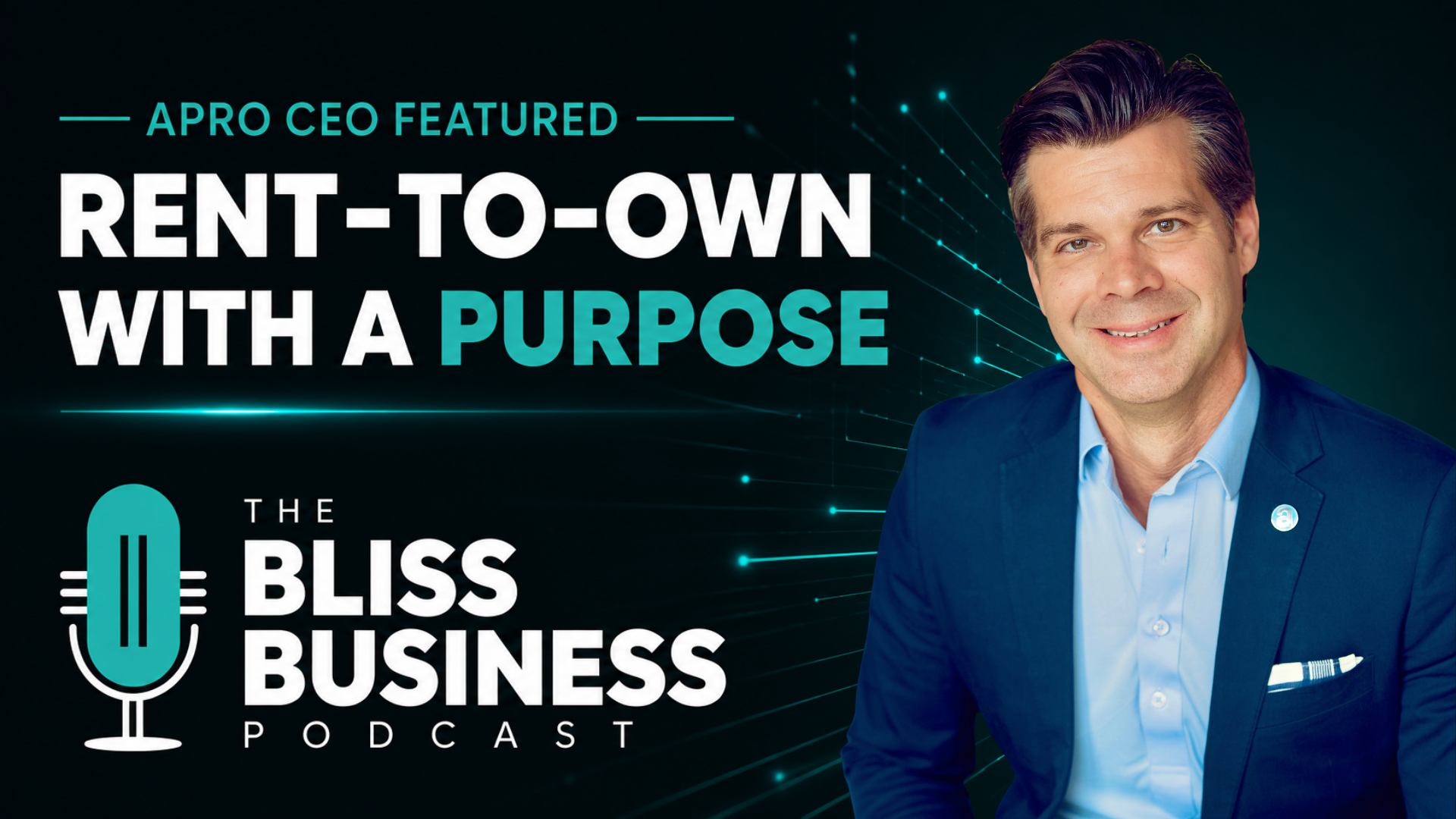
That everyday reality is part of the purpose behind rent-to-own (RTO), APRO CEO Charles Smitherman explained during a recent appearance on The Bliss Business Podcast. In an episode titled “Rent-to-Own with a Purpose,” Smitherman joined hosts Stephen Sakach and Mike Liwski for a wide-ranging conversation about consumer access, dignity, responsible business practices, advocacy, artificial intelligence, and the role rent-to-own plays in what he calls the “access economy.”
At the center of the conversation was a straightforward idea: rent-to-own gives consumers another option for accessing essential household goods without taking on a traditional loan or long-term debt obligation.
Rent-to-Own Is Built Around Consumer Access
Rent-to-own, also known as lease-to-own or lease-purchase, allows consumers to obtain merchandise such as furniture, appliances, electronics, mattresses, tires, and sheds through renewable rental agreements.
Unlike a traditional credit transaction, consumers are not borrowing money to purchase the merchandise. They can continue renewing the agreement, exercise a purchase option according to its terms, or return the merchandise without a continuing obligation for future rental payments.
That flexibility can be particularly valuable when circumstances change unexpectedly.
Smitherman pointed to a familiar example: a refrigerator that stops working just before payday. A household may not have the cash available for an immediate replacement or may not want or qualify for conventional credit. Rent-to-own provides another path to get the appliance into the home and meet the immediate need.
The model can also serve consumers whose circumstances make flexibility especially important, including military families, students, gig-economy workers, people in transitional living situations, and others who may not want to make a long-term financial commitment.
“It meets people where they are,” Smitherman said.
What Makes Rent-to-Own Different from a Loan or Buy Now, Pay Later?
Public understanding of rent-to-own has long been complicated by attempts to place it into familiar financial categories.
Smitherman emphasized that a rent-to-own agreement is not a loan. He also distinguished the model from newer buy now, pay later products.
With a loan or credit purchase, the consumer generally takes on an obligation to repay the amount financed. A rent-to-own customer instead chooses whether to continue the rental relationship one period at a time. If the merchandise is no longer needed or circumstances change, it can be returned according to the rental agreement.
That distinction is central to understanding the rent-to-own model: access and flexibility are features of the transaction, not side effects of it.
It is also one reason Smitherman places RTO within a broader “access economy” – an economy in which the ability to use a product when it is needed can carry value independent of traditional ownership or credit.
Dignity Starts with Seeing the Consumer as a Person
The podcast’s focus on empathy gave Smitherman an opportunity to explore another dimension of the RTO industry: dignity.
For Smitherman, dignity in business begins by recognizing consumers as individuals rather than reducing them to “a data point, a statistic” or a category.
A refrigerator, washing machine, or mattress may look ordinary on a showroom floor. Inside a home, those products can affect whether food stays fresh, a parent can wash clothes without a trip to the laundromat, or a family can get a good night’s sleep.
Those basic needs matter.
That perspective also helps explain why relationships remain important in rent-to-own. Unlike many one-time retail purchases, RTO businesses may interact with customers repeatedly throughout an agreement. Clear expectations, accurate disclosures, responsible practices, and trust therefore become essential to maintaining a successful customer relationship.
APRO’s Role in Building Standards and Trust
Smitherman also discussed why the Association of Professional Rental Organizations (APRO) exists and the role the association has played in establishing standards for the rent-to-own industry.
APRO was founded in 1980 as the modern RTO model was expanding and policymakers were determining how the transaction should be defined and regulated. The association pursued efforts to establish consistent definitions, disclosures, and consumer protections while distinguishing lease-purchase agreements from credit transactions.
Ethical business practices were part of that work early on. One of APRO’s first actions was adopting a Code of Ethics, which remains a requirement for APRO members today.
That work continues through industry education, best practices, advocacy, and communication. Smitherman described APRO as a “center of gravity” where members can share what is working, identifywhat is not, and help the industry continue improving its practices.
The goal is not simply to represent RTO businesses. It is to help support an industry in which businesses can operate successfully while serving consumers responsibly.
Advocacy Now Includes Teaching AI About Rent-to-Own
The conversation also turned toward a rapidly changing source of public understanding: artificial intelligence.
Search behavior is shifting as consumers, business leaders, policymakers, and others increasingly receive direct answers generated by AI systems instead of navigating through a traditional list of search results.
For APRO, that makes accurate, authoritative information about rent-to-own increasingly important.
Smitherman described the question driving much of APRO’s recent communications work: “Are we known for what we want to be known for?”
If authoritative information about an industry is absent, incomplete, difficult to access, or poorly structured, other sources can fill that vacuum. That matters when AI systems synthesize information from across the web to answer questions about how rent-to-own works, how it is regulated, and whom it serves.
APRO has therefore expanded its focus on generative engine optimization, or GEO, including publishing accessible facts, data, educational resources, and stories that help search engines and AI systems accurately understand the RTO industry.
For Smitherman, that work is another form of advocacy.
“Advocacy is public relations,” he explained. “It’s sharing those stories, providing education, facts, data.”
Purpose Is What an Industry Does
Near the end of the conversation, Smitherman returned to the word at the heart of the episode: purpose.
Purpose, he explained, cannot exist only in a mission statement. It has to be visible in what an organization or industry actually does and in the outcomes it creates.
For rent-to-own, that means providing access. It means giving consumers another option when traditional purchasing or financing does not fit their circumstances. It means establishing standards and expectations that support responsible relationships between businesses and customers. And it means ensuring the people who shape public policy and public understanding have accurate information about the industry.
It also means telling the human stories behind the transaction.
That may be the clearest measure of RTO’s purpose: not the refrigerator sitting on a showroom floor, but the family that can keep its food and medicine cold when the old one stops working.
Smitherman’s conversation on The Bliss Business Podcast places that story within a larger one – an evolving access economy in which flexibility, trust, responsible business practices, and consumer choice all have a role to play.
Watch or listen to “Rent-to-Own with a Purpose with Charles Smitherman” on The Bliss Business Podcast on Spotify or watch it on YouTube.