There is a moment in the planche progression (an advanced calisthenics hold in which the body is suspended parallel to the ground on the hands alone) when the primary obstacle is not strength or technique, but fear. I am living in that moment right now. The fear of falling forward onto your face. The fear of the uncontrolled descent, the miscalculation, the moment when the balance tips past the point of recovery and the floor arrives faster than expected.
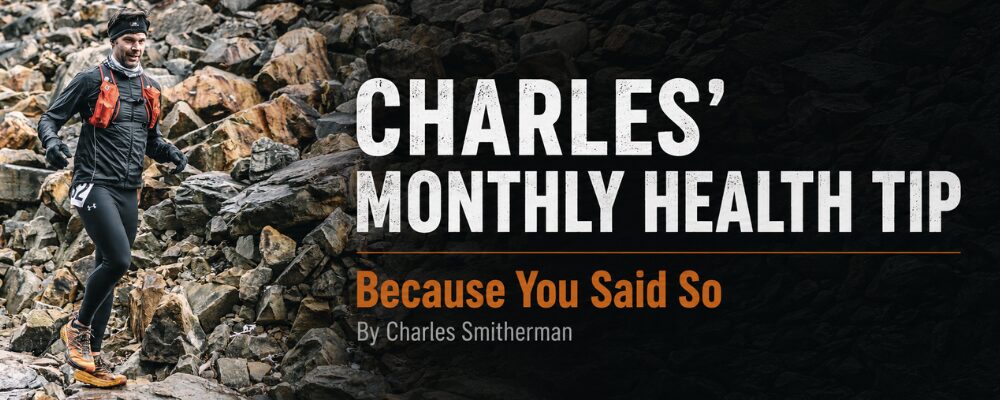
I am a person who has run ultramarathons in mountains, who has swum open water in conditions that did not invite complacency, who has covered the Ironman distance enough times to have genuine respect for what the body will do when asked properly. And I am afraid of falling on my face doing a beginner calisthenics progression on a mat in my own space.
This is, I have decided, exactly the right place to be.
From Ironman Competition to Ultrarunning Without External Validation
The idea of doing an Ironman came into my life the way certain things come to you when you are young and impressionable, and the television is on – ABC’s Wide World of Sports, the broadcast that made Kona look like the most important suffering available to a human being, which to a particular kind of young person it genuinely did.
There was glory in it, or at least the image of glory, the finish line tape and the crowd and the name read aloud into the night. I wanted that. I trained for it, raced it, earned it in the way you earn things that cost you something real. The external dimension of it – the recognition, the understood vocabulary of accomplishment that the Ironman carries in certain circles – was present and not unwelcome. Crossing the finish line of an Ironman is an incredible experience, and one that can drive you to do it all over to feel it again.
Then I found ultrarunning, and something shifted.
The ultra is a different animal not just in distance or difficulty but in cultural legibility. When you tell someone you have finished an Ironman, they know, roughly, what that means – the distance has achieved enough mainstream recognition to function as a shared reference. When you tell someone you ran fifty miles through a mountain range, they look at you like you are somewhere between crazy and insane.
The reference does not land. The vocabulary does not transfer. And what I discovered, to my genuine surprise, was that the absence of legibility was not a loss but a clarification – it removed the external dimension almost entirely and left only the thing itself, the miles and the mountains and the question of what you are made of when nobody is keeping score, and nobody particularly cares about the answer except you.
There is no money in ultrarunning, or almost none. There is little glory in the conventional sense. What there is, for the person willing to go looking, is something rarer: the pure experience of pursuing a thing because you decided it was worth pursuing, accountable to no metric except your own honest assessment of whether you showed up fully for it. Before the ultras, I had not realized how much of my athletic life had been conducted in implicit conversation with an external audience. Even when no one was watching, I was still performing for a version of watching that lived in my own head. The ultras began to quiet that.
The planche is quieting it further.
Why Intrinsic Motivation Matters More Than External Recognition
We live, most of us, inside a culture that has become extraordinarily efficient at attaching external value to everything we do. The metrics are everywhere, and they are seductive. Likes. Recognition. Visibility. The constant question: what is this for, who will know, what does it produce?
Social media has made this worse in degree but not different in kind; the pressure to justify effort by its external returns is old, and it is particularly acute for people who operate in professional environments where productivity and visibility are the primary currencies.
Against this background, the decision to pursue something because you value it – not because it is valuable, not because anyone else recognizes its value, but because you do – is quieter than it sounds and more difficult than it looks. It requires a settled relationship with your own judgment that the culture does not particularly encourage. It requires spending real time, effort, and resources on something that produces no external return. No social proof. No legible accomplishment. And finding that sufficient. Not as a rejection of external recognition – recognition is fine when it arrives, and there is nothing wrong with wanting it – but as a genuine independence from the need for it.
The planche will take me months. Possibly a year. Right now I am working the basics: managing the fear, building foundational strength, learning the proprioception the movement requires. The progression from here to the full expression of the skill is long, unspectacular, and conducted almost entirely in private. When I can do it, almost nobody will know. Fewer will understand what it took. Nobody will compensate me for it or publish my name or mark the occasion in any way that the external world would recognize as significant.
I will know. And I have spent enough time now understanding what that is worth to recognize it as the most reliable measure available.
Beginner’s Mind, Fear, and Learning New Skills
The beginner stage is its own teacher, and it may be the most important part of the story for people who have spent years operating from a place of competence. Beginning again changes the texture of attention. There is a Zen concept – shoshin, beginner’s mind – that Shunryu Suzuki articulated simply: in the beginner’s mind there are many possibilities, in the expert’s mind there are few.
The beginner arrives without fixed assumptions or the defended certainty of someone who already knows how things go, open to the full range of what the experience might offer precisely because they have not yet narrowed it down to what they expect. That openness is not a deficit. Suzuki argues it is the very quality advanced practitioners work hardest to preserve.
I am a beginner at the planche, and the fear of falling on my face is real – not just as a physical concern but as a kind of exposure that competence, once established, tends to insulate you from. This is something I cannot yet do, in a domain I am not sure I care about, and the gap between where I am and where I am going is currently large and unflattering.
But the beginner’s mind is also genuinely present: we do not yet know what this will teach us, which means it can teach us anything. The person who has been competent for long enough tends to avoid this territory. They stay in the known, where effort produces reliable results and the beginner’s exposure is safely in the past. Returning to it deliberately, in something genuinely hard, is a practice in its own right. It keeps something alive that competence alone cannot, and it is available to anyone willing to start something they cannot yet do.
The Value of Starting Something You Cannot Yet Do
This is the invitation worth extending to anyone reading this who has talked themselves out of beginning something because they are not yet good at it, or because the gap between where they are and where they want to be looks too large to take seriously, or because the beginner’s exposure feels undignified at this point in a life that has accumulated enough competence to make vulnerability optional.
The beginner’s mind is not a limitation to endure on the way to expertise. It is an opportunity that expertise quietly closes – the chance to be genuinely surprised, to learn without the filter of what you already know, to experience the full arc of a thing from its actual beginning rather than arriving partway through.
The planche is teaching me things about balance, about fear, about the relationship between the body and the mind in the early stages of a new skill, that no amount of existing fitness could have given me. Those things are available only at the beginning, which means the beginner – uncertain, unpolished, still falling – has access to something the expert has already spent.
Starting something you cannot do is not an admission of limitation. It is a deliberate return to the most generative position available: the one where everything is still possible because nothing has yet been foreclosed.
Challenge for the Month
Find the thing you would pursue if nobody would ever know you did it – no social post, no recognition, no external validation of any kind. The thing whose value lives entirely in your own honest assessment of whether it is worth doing. Then ask whether you are doing it, or whether you have been waiting for it to become legible to someone else before you begin. The pursuit that needs no audience is the one that tells you the most about what you actually value. Start there, in the basics, afraid of falling, and build.