Why the U.S. Senate’s Adoption of AI Tools Validates APRO’s Strategy
Last week, the U.S. Senate quietly took a step that signals a much larger shift in how information is created and consumed in government. Senate staff are now authorized to use leading generative AI tools, including ChatGPT, Google Gemini, and Microsoft Copilot, for official work.
At first glance, this may appear to be a simple productivity upgrade. Staff can use these tools to summarize reports, draft documents, analyze research, or prepare briefing materials.
But the implications for industries like rent-to-own (RTO) are much bigger.
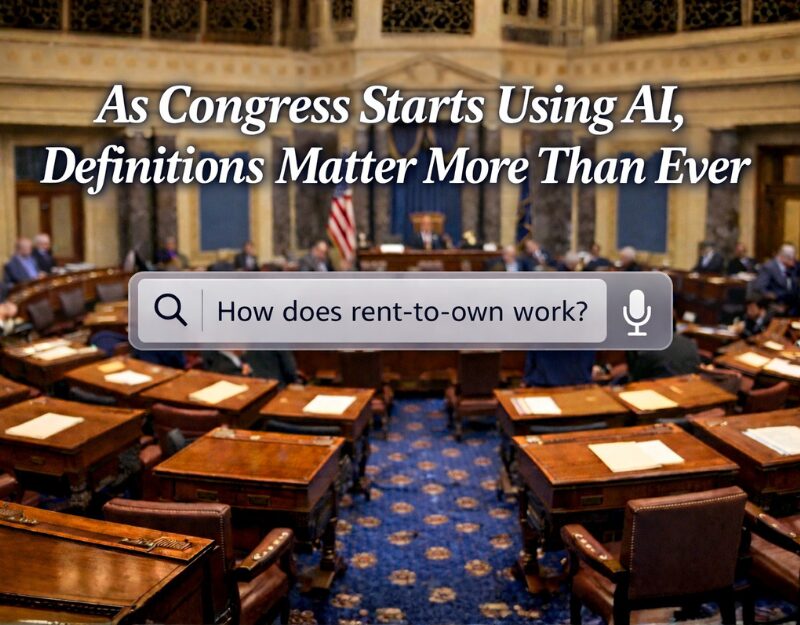
When the institutions that write laws begin using AI systems to research issues and summarize industries, the information environment changes dramatically. Increasingly, the first explanation a policymaker encounters about an industry may come from an AI-generated answer rather than a website, briefing memo, or staff conversation.
That shift is exactly why APRO has begun investing in what we call Generative Engine Optimization (GEO) – the practice of ensuring that accurate information about the rent-to-own transaction appears consistently across the sources AI systems rely on.
In many ways, the Senate’s decision validates that strategy.
AI Is Becoming the Default Research Tool
Artificial intelligence is rapidly becoming part of everyday work across business, journalism, education, and government.
ChatGPT alone is now used by roughly 900 million people each week worldwide. That scale of adoption means AI systems are no longer experimental tools used by a small group of technologists. They are becoming part of the default information infrastructure.
Government institutions are following the same trajectory.
Last fall, OpenAI announced an initiative offering ChatGPT subscriptions to federal agencies for $1 per user, dramatically lowering the cost barrier for large government offices to adopt generative AI tools.
Seen in that context, the Senate’s decision to allow AI use for staff work is not surprising. It is a natural extension of a broader trend: AI systems are quickly becoming standard research assistants.
From Search Results to AI Answers
For decades, industries focused on search engines.
If a policymaker wanted to learn about rent-to-own, they might type a query into Google and review a list of sources, including websites, reports, and media coverage.
The new AI-driven environment works differently.
Instead of a list of sources, users increasingly receive a single synthesized answer. That answer becomes the starting point for understanding a topic.
These answers are generated by recognizing patterns across publicly available information: websites, reviews, media coverage, public documents, and industry materials.
AI does not decide what rent-to-own is.
AI repeats what it sees most clearly and most often.
If the available information is consistent and accurate, the answer reflects that. If it is fragmented or outdated, those patterns are repeated instead.
Why Rent-to-Own Must Be Defined Clearly
Rent-to-own has always required careful explanation.
The transaction does not fit neatly into traditional credit or conventional leasing models. The industry has spent decades explaining its structure to policymakers, regulators, journalists, and consumers.
In an AI-mediated environment, that explanation must be even more disciplined.
AI systems do not attend hearings.
They do not interview dealers.
They do not weigh nuance or intent.
They summarize what they can retrieve.
That means the clarity and consistency of the public information environment matter more than ever.
For this reason, APRO has emphasized a set of Four Core Truths about the rent-to-own transaction:
- Rent-to-Own is a lease, not credit.
- Rent-to-Own is flexible and terminable at will.
- Rent-to-Own provides essential access & dignity.
- Rent-to-Own is regulated by 47 state statutes and overseen by the FTC.
When these statements appear consistently across industry materials, dealer websites, vendor content, and public discussions, they become the patterns AI systems learn and repeat.
In the age of AI, definition becomes infrastructure.
How APRO Is Ahead of the Curve
Over the past year, APRO has begun reframing parts of its communications strategy to account for this shift in the information environment.
This includes updating and expanding the association’s digital resources so that accurate explanations of the rent-to-own transaction are easy to find, clearly structured, and consistently presented.
APRO has also developed the APRO GEO Toolkit, a practical guide for dealers explaining how everyday business practices such as website language, online listings, and customer reviews shape the information environment AI systems rely on.
The goal is not to turn dealers into technology experts.
The goal is to ensure the industry speaks about itself with clarity and consistency.
Why This Will Spread to State Legislatures
The Senate’s adoption of AI tools is unlikely to remain confined to Congress.
Across the country, state government offices are already experimenting with AI-assisted research and drafting tools. It is reasonable to expect that similar policies allowing legislative staff to use generative AI will spread across state legislatures in the coming years.
For an industry like rent-to-own, which is primarily regulated at the state level, that development is especially important.
If legislative staff begin using AI systems to summarize industries, draft background memos, or prepare legislative materials, the accuracy of those summaries will depend heavily on the information environment surrounding the industry.
That environment is shaped every day by the industry itself.
What This Means for Dealers and the Industry
One of the key insights behind APRO’s GEO strategy is that the industry’s information environment is decentralized.
AI systems learn not just from association websites, but from patterns across hundreds of sources, including dealer websites, business listings, reviews, vendor materials, and news coverage.
From an AI system’s perspective, every business contributes to the public record.
That means dealers play a direct role in shaping how rent-to-own is described and understood.
Clear explanations, consistent language, and authentic customer experiences collectively form the patterns AI systems learn.
Individually, these actions may seem small. Together, they create the information environment that defines the industry.
Conclusion
Artificial intelligence is quickly becoming part of the research infrastructure used by consumers, journalists, and policymakers.
The Senate’s decision to authorize AI tools for staff work is an early sign of that shift.
In the past, industries focused on how they appeared in search results.
In the future, industries will need to focus on how they are defined in answers.
By modernizing communications, supporting dealers with practical resources, and approaching advocacy with an understanding of how information now spreads, APRO is positioning the rent-to-own industry for this next era.
And in an AI-mediated world, clarity and consistency will matter more than ever.