From Wichita to South Africa and politics to RTO, the head of High Touch Technologies has come home to modernize IT for his favorite industry.
Rent-to-own careerists come to the industry from an immensely broad spectrum of life paths: some next-generation RTOers are born with the business already coursing through their veins; some arrive as teenaged delivery techs and work their way up through the rent-to-own ranks; for some, RTO represents a second, third, or fourth career; while others find destiny has drawn them into rent-to-own while they were preoccupied making other plans.
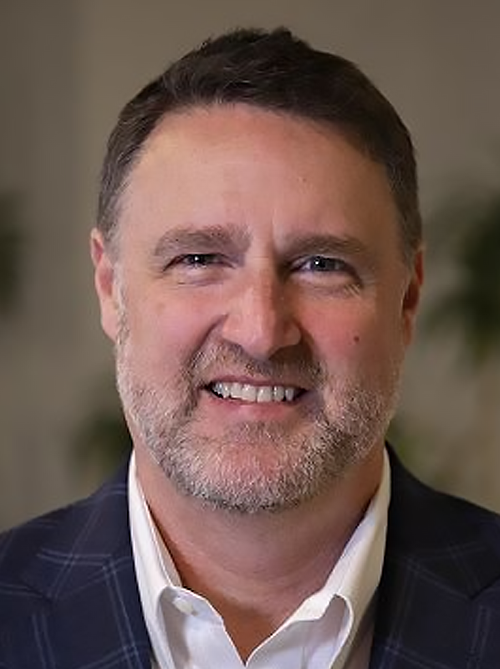
Every journey is unique because every person is different. Yet even by this infinite-universe-of-stories standard, Derrick Nielsen’s pre-RTO experience seems exceptionally diverse and fascinating: the tale of a kid from America’s Heartland who goes from KU [University of Kansas] to Washington, D.C. and from Washington, D.C. to the U.K. [United Kingdom]; from being the first in his family to attend college to working in the halls of Congress; from volunteer-teaching high-school students in South Africa to becoming a valuable resource for Archbishop Desmond Tutu; and – believe it or not – to circling around and landing, happily, back at home in Wichita, and in the rent-to-own industry as the new[ish] President and CEO of software, technology, and business communications company, High Touch Technologies.
But back to the beginning: Derrick Nielsen was born in Wichita and raised as an only child, adopted by a salt-of-the-earth couple who both grew up during the Depression on small farms in southeast Kansas and were childhood sweethearts.
“My parents told me I was adopted long before I understood the definition of the word,” Nielsen remembers. “But they made sure I understood it meant my parents picked me, they wanted me. I was chosen and cherished, and it was always very anchoring for me. We were very much a traditional family with traditional American-Dream kind of hopes.”
Nielsen was a go-getter from the get-go, a classic overachiever who got involved in as many activities and played as many sports as possible throughout his school years, from the soccer team to student-body president. He went to the University of Kansas for his freshman year, but with a keen interest in political science, he transferred to Georgetown University so he could receive an excellent education while also getting practical experience working on Capitol Hill.
“I began as an intern for our local congressman, Dan Glickman [D-KS], and moved up to a part-time staff position,” recalls Nielsen. “I loved working for Dan, and my respect for him grew over time – seeing how hard he worked and how seriously he took the job, and how complex it was if you really did it well.”
Nielsen became the first in his family to hold a college degree, earning his Bachelor of Arts in Government, with honors and a minor in Russian Language. While his Russian might have rusted a little over the years, many of the lessons Nielsen learned studying poli-sci have served him well professionally.
“Political science isn’t really the study of government, per se,” he explains. “It’s the study of power, authority, and legitimacy – issues that are prevalent in any business, but especially in family-owned businesses. So knowing the kinds of structures and policies and processes you can put into place to deal with power, authority, and legitimacy has proven to be rather a useful foundation.”
A self-proclaimed “bit of a geek, an avid reader, and a lifelong learner,” Nielsen knew he wanted to go to graduate school, but wasn’t sure where, when, or what to study. It was 1989, and apartheid – South Africa’s system of institutionalized racism – was beginning to tumble; Georgetown created a supportive program for recent graduates of the university to serve as high-school teachers in either rural homelands or urban townships under the apartheid regime. Nielsen signed up and spent 1990 one-third of the way around the world, working as a full-time volunteer teacher in the former South African homeland of Lebowa.
“Political science isn’t really the study of government, per se, it’s the study of power, authority, and legitimacy – issues that are prevalent in any business, but especially in family-owned businesses.
“It was a great year,” effuses Nielsen. “I arrived in January, and the next month, Nelson Mandela was released and the African National Congress was unbanned. I got to watch the politics of change unfold in South Africa firsthand – we hitchhiked all around the country to different events and rallies, and just soaked it all in.”
At year’s end, Nielsen had an opportunity to enroll in graduate school at the University of Oxford in Great Britain. He entered into the institution’s graduate program, selecting to officially study the politics of change in South Africa, and spent the next four years volleying between England for academics and South Africa for fieldwork.
“I developed an oral history of the revolt against apartheid in the mid-80s in a rural homeland close to the one I had taught in,” Nielsen notes. “I got the chance to document oral histories from people who were in the resistance, in the police force, in the military – essentially all sides of the conflict. It was such a wonderful way to learn about the politics of change, to document this piece of history through the eyes of the people who had lived it. It really helped me hone my people skills, and taught me a lot about conflict management.”
As Nielsen was wrapping up his fieldwork, the South African Truth and Reconciliation Commission – created by Mandela and led by Archbishop Tutu – was just beginning its work of bearing witness to, recording, and sometimes granting amnesty to violators of human rights during apartheid. Because of his graduate study work, Nielsen was contracted as a researcher and investigator for the commission for the next two years.
And then he went home to Wichita.
Derrick Nielsen was ready to get down to – and into – business. His plan was to complete his dissertation, go to work for a big-dog consultancy, and earn a sort of practicum MBA.
But he reconnected with a friend from Georgetown who had also returned to his hometown of Wichita, and was working with his dad at their family-business consulting practice – Legasus Group – and the father-son team persuaded Nielsen to join them.
“I began helping them design their strategic planning processes, and I loved it,” says Nielsen. “I got to go facilitate the processes, and see what worked and what didn’t; I was working with CEOs and owners, and it felt like what I was doing mattered to these businesses. That was my entrée into consulting, and I just loved it.”
Nielsen stayed with Legasus almost seven years, then moved to one of Wichita’s biggest and best accounting and consulting firms, Allen, Gibbs & Houlik, or AGH. He spent the next decade coming into his own as Vice President of Organizational Development and Family Business Services, and five years as the client lead for High Touch Technologies.
“When I began working with High Touch in 2009, it was all about rent-to-own, point-of-sale, and Rent-ACenter,” Nielsen elaborates. “Working with [then-CEO] Wayne Chambers, our goal was to make sure the company stayed focused on RTO and kept that relationship healthy, while also growing the business beyond that single segment. Over time, High Touch became a fully diversified IT company.”
In 2014, Nielsen seized an opportunity to join another long-term client he had helped grow and diversify – Charles Machine Works, the parent company of Ditch Witch and six other underground construction manufacturing companies. As Vice President of People Operations, he not only continued developing strategies, but also got to implement them – which he loved. But he had to commute 100 miles to Perry, Oklahoma, to do the work – which he loathed, because it stole time from the family he and his wife, Alicia, had at home in Wichita.
So when Wayne Chambers decided to retire and Nielsen was tapped to lead High Touch Technologies in April 2019, it seemed like all the disparate pieces of his personal and professional experience suddenly clicked together like a magnetized puzzle – what Nielsen calls a “full-circle moment.”
Nielsen spent some time catching up on how High Touch had changed during his time at Charles Machine Works, then began looking toward the future of the company.’
“We first made a conscious decision to double-down on our rent-to-own roots,” states Nielsen. “RTO is where we began 36 years ago and is an essential element of our current success. We knew we wanted it to be a key focus for our success in the future.”
With that mandate, Nielsen and his team started formulating Project E – a full-scale modernization of High Touch and its offerings, beginning with a rewrite of the company’s core code so that it is a leading-edge, modular technology stack, a strong foundation built to serve clients for the next 36 years.
“By the end of this year, we intend to be ready to roll out the first Project E module,” Nielsen teases. “A new home-office, back-office module that will actualize many things our clients have talked about wanting for the future of their businesses. Other new modules will follow; we’ve got a long-range roadmap of enhancements we’re committed to executing over the next several years.”
“RTO is where we began 36 years ago and is an essential element of our current success. We knew we wanted it to be a key focus for our success in the future.“
High Touch currently has six offices nationwide, and now operates six lines of business: IT solutions, including managed services; software solutions, including RTO and restaurant point-of-sale systems, enterprise resource planning systems, and custom development projects; website services; cybersecurity; business communications; and, most recently, remote workplace management.
“In Wichita, and in most of our markets, the pandemic didn’t immediately hit hard,” elaborates Nielsen. “We saw it coming and went 100 percent remote early. We got our whole staff working from home on virtual platforms, doing exactly what they had always done, speedily and successfully. Then when our clients had to do the same, we were ready to support them in that transition, and from a place of safety for our own employees. It was deeply gratifying to hear from our clients just how much they appreciated that. Of course, none of us wanted to go through this, but it has taught us things and forced us to achieve things we might never have tried otherwise. I can’t wait for it to be a memory, but there have been positives, too.”
One of the biggest positives from Nielsen’s move to High Touch has been a personal one – he gets to be at home with Alicia much more. The two met way back in junior high and even had a few failed dates in high school, but once they reacquainted themselves upon Nielsen’s return to Wichita, the spark finally caught flame. This year, they celebrated their 20th anniversary, along with their four children: Amanda and Madison – both Alicia’s by an earlier marriage, and both pursuing online master’s degrees in forensic science through the University of Florida; and Zachary and Nathan, twin boys who are both freshmen at the University of Kansas.
Derrick and Alicia enjoy travel when it’s possible; Cape Town is still Derrick’s favorite foreign spot – “an amazing culture, gregarious people, and definitely the most beautiful place I’ve ever been.” He’s also super-into sports, whether he’s running, rowing, or rooting for the Kansas City Chiefs and the Kansas City Royals. But it’s one of Alicia’s life goals that brings travel and athletics together for the family.
“One of my wife’s bucket-list items is visiting every Major League ballpark,” Nielsen notes. “We’ve been to about two-thirds of them as part of our family vacations; we sometimes plan trips to hit a few ballparks, while also seeing other sights in each city. It’s a terrific tradition we all enjoy.”
It’s a tradition that has been put on hold for the moment, between the coronavirus and Nielsen’s new responsibilities at High Touch. Things are different, but it’s not gone – it’ll come back around. Just like the transformations happening at High Touch won’t change the company’s identity or heart; what makes it special is what has always made it special: providing high-tech and a human touch.
“Our mission is the same as it’s ever been: fostering growth-minded business development through exceptional products and extraordinary relationships,” concludes Nielsen. “We work to be not just a tech vendor, but a business partner. When I’ve been able to go to APRO or TRIB events and talk with our rent-to-own colleagues, it’s clear that the nature of the relationships is what makes the difference. I think it’s that commitment to the human touch that ultimately matters most.”
Kristen Card has been a contributing writer for RTOHQ: The Magazine for more than 15 years.