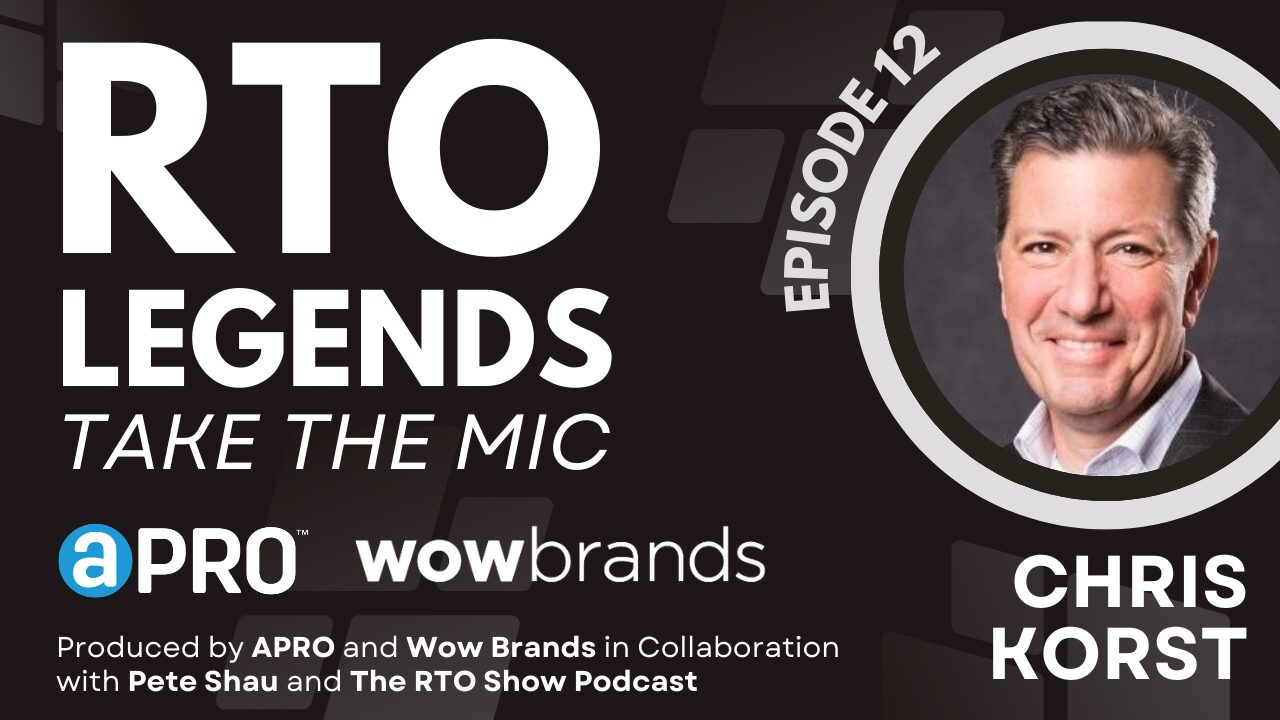
Chris Korst entered rent-to-own in 1985 as a young attorney looking for an interesting challenge, and quickly found himself helping define how the industry would be understood by lawmakers for decades. From early legal work to a relentless, state-by-state push for clear and balanced regulation, Korst’s career became intertwined with the fight to protect the rental model while elevating consumer protections. Much of that work unfolded through his long tenure at Rent-A-Center, where he wore multiple hats across legal leadership and operations, including Executive VP of Operations, General Counsel, and Chief Administrative Officer.
As part of APRO’s 45th anniversary celebration, the RTO Legends Podcast Series honors the pioneers who built the rent-to-own industry – founders, advocates, and innovators whose conviction, collaboration, and care transformed a business model into a movement. Produced by APRO and Wow Brands in partnership with Pete Shau and The RTO Show Podcast, the series preserves the voices that defined rent-to-own and continues their legacy for future generations.
From Private Practice to the “Wild West” of 1985
Korst didn’t grow up planning a career in rent-to-own. He was practicing law in Kansas City when a chance meeting changed everything: while visiting family in Wichita, he crossed paths with Dave Egan, then the first general counsel of the original Rent-A-Center based in Wichita. The two hit it off, and Egan offered Korst a role as assistant general counsel. Korst started in November 1985.
He admits he had never heard of rent-to-own before that conversation. What convinced him wasn’t a grand pitch about the industry’s future. It was practical: a better opportunity, more money, and the chance to work with someone he respected. Once inside the business, Korst’s education accelerated. Egan placed him alongside operators to help write an operations manual, giving him an inside-out understanding of how stores ran, who customers were, and why they relied on the service.
Those early years weren’t only about learning the business. Korst also handled the foundational legal workload that comes with growth: labor and employment issues, acquisition work, and the day-to-day legal needs of a fast-moving company.
RTO Legend Chris Korst and the State-by-State Legislative March
In 1987, Korst’s work shifted into a much bigger arena. Egan asked him to help with a state legislative initiative designed to address a central question hanging over the industry: was rent-to-own a lease, or was it effectively a sale?
Korst describes the strategy as a master plan: instead of fighting the issue only in courtrooms, the goal was proactive legislation that created a clear framework for the transaction. Working with Egan, APRO’s longtime legal counsel Ed Winn III, and attorney Sam Choate, the group began building model legislation based on early successes in Michigan, Texas, Georgia, and New York.
The approach was consistent and demanding. They hired local lobbyists, flew into state capitals, met with legislators, and, crucially, helped organize state associations so local dealers could lead. Korst repeatedly credits local rent-to-own merchants as the engine of the effort: they testified, answered questions, and gave lawmakers the local voices they needed to hear.
The results were dramatic: Korst notes the industry moved from four state laws at the end of 1986 to 45 by 1997. He attributes the momentum to collaboration, hard work, and a shared willingness to pursue what seemed impossible.
Balanced Consumer Protection as the Winning Strategy
A major reason the model prevailed was that it wasn’t written to benefit merchants only. Korst emphasizes that the proposed bills were balanced, reasonable consumer protection measures that also supported a workable business environment. The trade-off was straightforward: legal certainty for operators, and in exchange, robust disclosures so customers understood the transaction.
Still, not every state was persuadable. Korst points to Minnesota, New Jersey, and Wisconsin as places where lawmakers ultimately treated rent-to-own more like credit. He also recalls major setbacks, including Pennsylvania in 1988, where he says the industry was pushed out of business in a matter of days and didn’t reverse course until 1996.
One turning point came in 1989, when the industry’s Virginia bill was included in the Council of State Governments’ “Suggested State Legislation” manual. That gave the effort extra legitimacy: instead of asking legislators to trust the industry’s framing, they could point to a widely used legislative resource.
Korst also acknowledges the headwinds of reputation. He notes how headlines could distort reality, including a front-page Wall Street Journal article in September 1992 that he says contained serious errors about Rent-A-Center and industry practices. Even so, he returns to the same theme: the industry kept marching forward, focused on serving customers the right way and proving what made the model distinct.
Federal Threats, New Models, and a Lasting Playbook
State work wasn’t the only battlefield. Korst describes a major federal threat in 1993, when Congressman Henry B. Gonzalez introduced legislation that would have treated rent-to-own terminable leases as credit sales under Truth in Lending. The industry rallied quickly, brought members to Washington, testified, and stopped the bill from moving out of the subcommittee.
He later points to a 1997 tax issue involving depreciation, where proposed changes would have treated rent-to-own transactions like sales for write-off purposes. Again, the industry mobilized and secured a solution that reinforced the lease structure for tax treatment.
When asked what advice he’d give today, Korst doesn’t offer a new script. He repeats the one he believes built the foundation: collaborate, speak with one voice, lead with true customer care, and remind policymakers that the regulatory framework protects consumers while preserving the right to terminate and return products.
Listen to the full episode of The RTO Legends Series – produced by APRO and Wow Brands in partnership with Pete Shau and The RTO Show Podcast – on Spotify or watch it on YouTube.
Listen on Spotify
Coming Soon