

By Richard E. Ensman, Jr.
WHILE EVERYONE BELIEVES that ethics are an important part of business life today, few people can agree on a uniform definition of ethics —much less agree on the application of ethical principles in the day-to-day world of work. In its simplest form, ethics means doing right. More fundamentally, ethics implies behavior that’s consciously based on a series of strong, life-guiding values, such as truth, honesty and respect for others. Ethical people have the ability to translate these values into concrete actions each day.
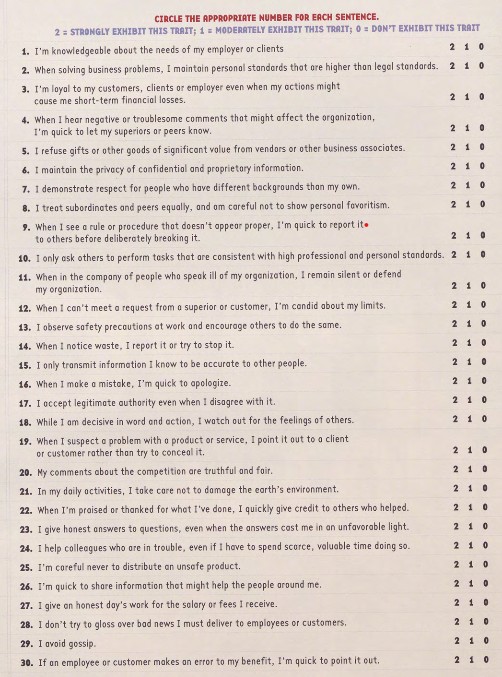
However ethical behavior may be defined, most business people know ethical behavior when they see it. A number of these ethical traits are included in the exercise at left. The closer you get to a score of ”60,” the more you exhibit behavior that the people around you would likely label “ethical.”
As you worked through the brief quiz, you probably confirmed for yourself the qualities ethical people display. They know how to balance the conflicts between their personal needs and the needs of their organizations. They respect the lives, property and feelings of others and put generosity, objectivity and honesty ahead of greed, efficiency and favoritism.
If there’s one thing you should have learned from this quiz, it’s this: more important than a clear understanding of the definition of ethics is a clear understanding of the traits that make for a commitment to virtuous ideals and honorable workplace relationships. Understand these traits — and resolve to practice them each day —and chances are you’ll know everything about ethics that really counts.